Cómo comprar maquinaria industrial en China: guía completa
Guía práctica para encontrar, verificar, comparar, inspeccionar y probar proveedores chinos de maquinaria industrial antes del envío.
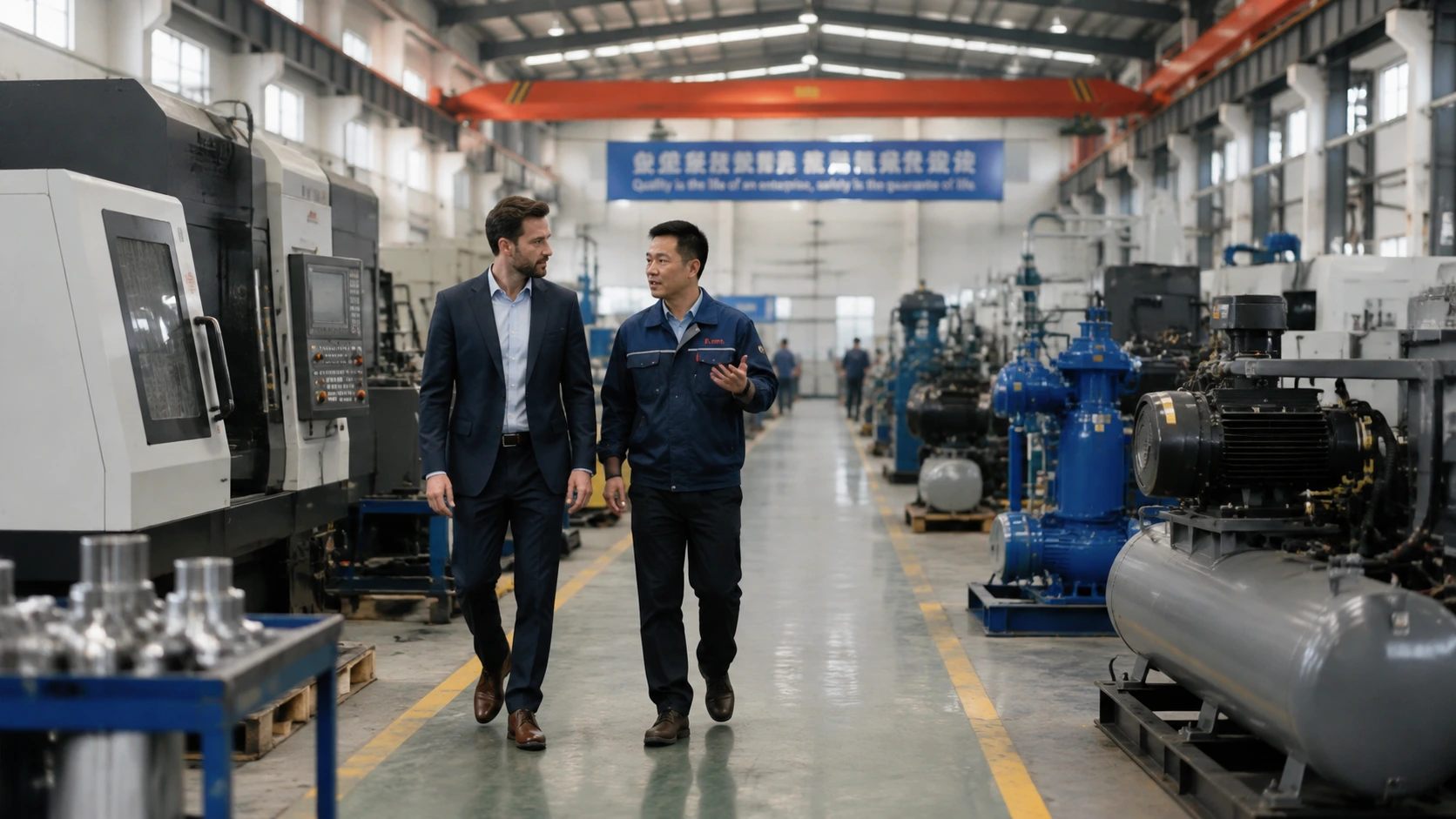

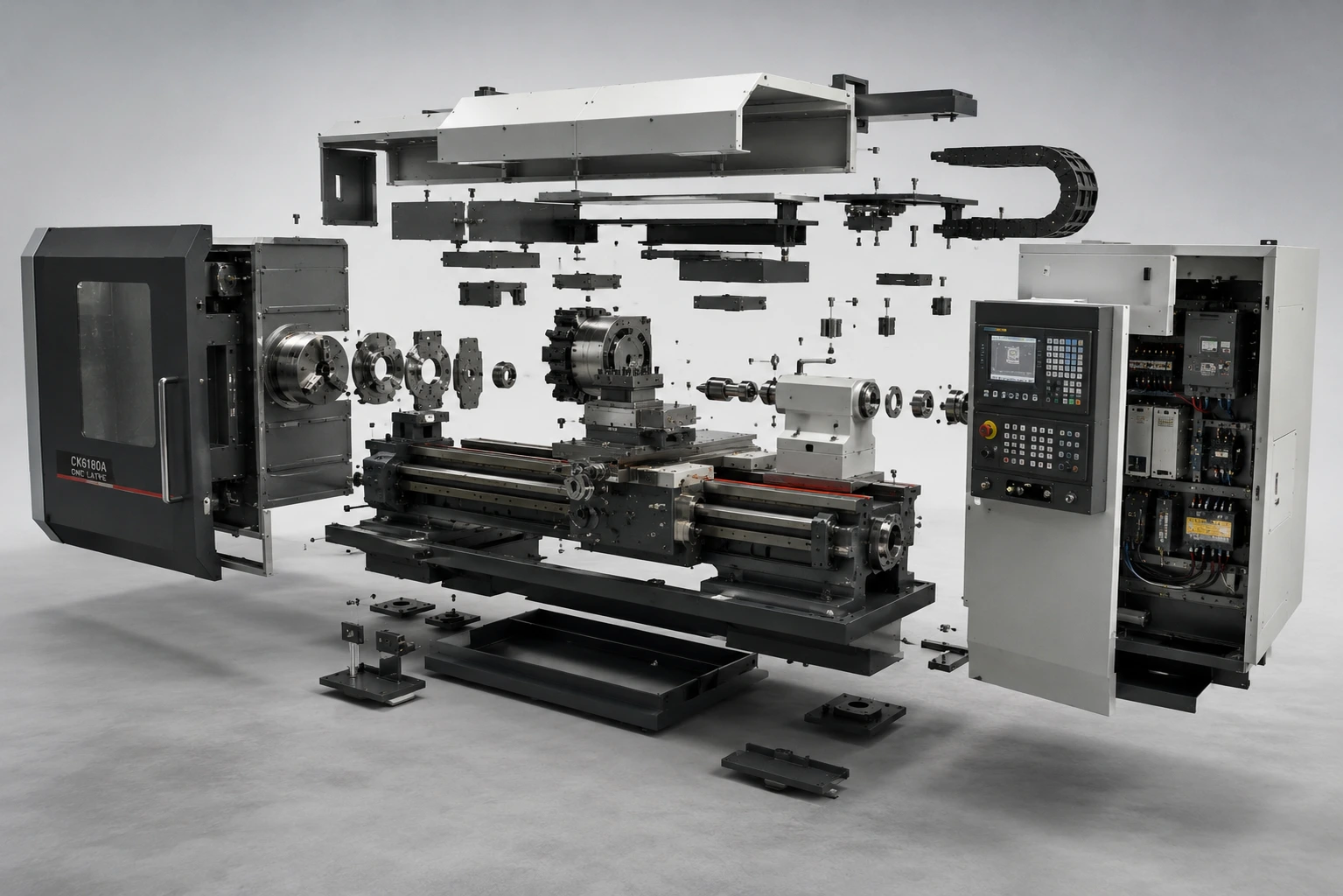
China offers international buyers access to a very large industrial supplier base. Air compressors, pumps, generators, CNC machines, packaging systems, production lines, construction equipment, electrical equipment and automation systems are available in a wide range of capacities and configurations.
The opportunity is significant, but industrial machinery is not an ordinary purchase. If a consumer product arrives defective, the buyer has a commercial problem. If an unsuitable machine is installed in a factory, the buyer may face downtime, excessive energy consumption, insufficient capacity, premature failure, safety problems, unavailable spare parts and expensive international repairs.
Finding a supplier is easy. Identifying the right manufacturer, defining the right machine and proving its performance before shipment require a controlled sourcing process.
Why source industrial machinery from China?
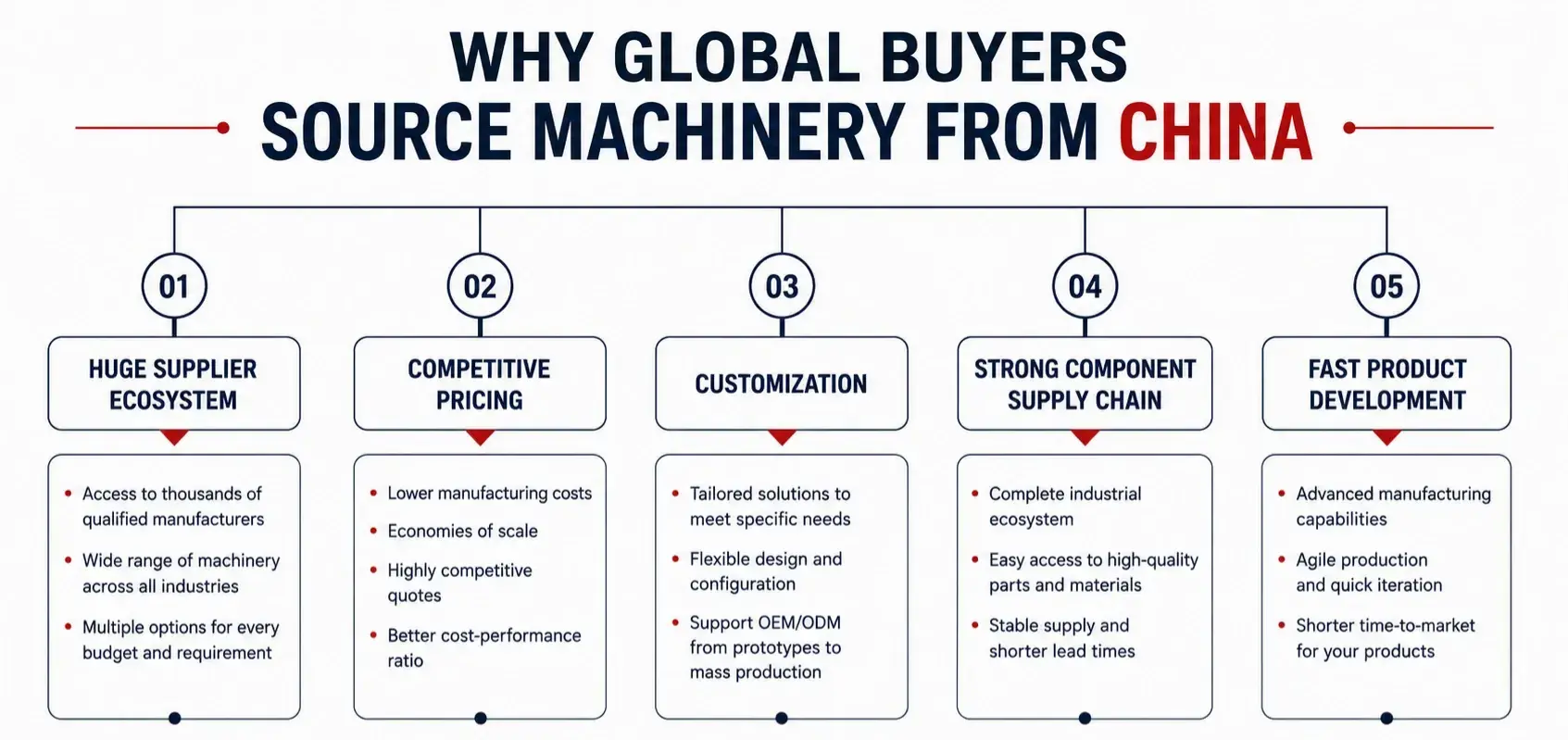
China's industrial ecosystem gives buyers access to dense networks of component suppliers, engineering companies, assemblers, specialized factories and export-service providers. In many categories, this creates a combination of broad choice, customization capability, competitive acquisition cost and relatively fast product development.
Common customization options include voltage, frequency, pressure, flow, capacity, dimensions, control architecture, communication protocol, safety configuration, branding and packaging. The exact possibilities depend on the machine and the manufacturer's engineering capability.
| Potential advantage | What the buyer must verify |
|---|---|
| Large supplier base | Which suppliers can genuinely meet the application and performance requirements |
| Dense component supply chain | The approved brand, model, origin and specification of every critical component |
| OEM and customization | Whether the change is engineered, documented and validated rather than improvised |
| Competitive pricing | Scope of supply, component quality, efficiency, warranty and total operating cost |
| Fast development | Design maturity, testing method, corrective-action process and delivery realism |
The number of available suppliers is itself a challenge. A polished website or highly visible marketplace listing does not prove manufacturing depth, engineering capability or consistent product quality.
Manufacturer, assembler or trading company: what is the difference?
The word manufacturer can describe very different business models. One company may machine and fabricate major parts internally. Another may purchase most components, outsource the frame, assemble the system, program the controller and test the finished machine. A trading company may coordinate the order while production takes place at a separate factory. For a focused comparison of these supplier structures, see Manufacturer vs Assembler vs Trading Company in China.
| Supplier type | Typical role | Main verification question |
|---|---|---|
| Integrated manufacturer | Engineering, fabrication, assembly, testing and quality control | Which processes and critical parts are genuinely completed internally? |
| Assembler or OEM | Component selection, system integration, assembly, programming and testing | Who supplies the components, and how are compatibility and performance validated? |
| Trading company | Supplier discovery, export communication and order coordination | Which factory will build the machine, and what technical value and accountability does the trader add? |
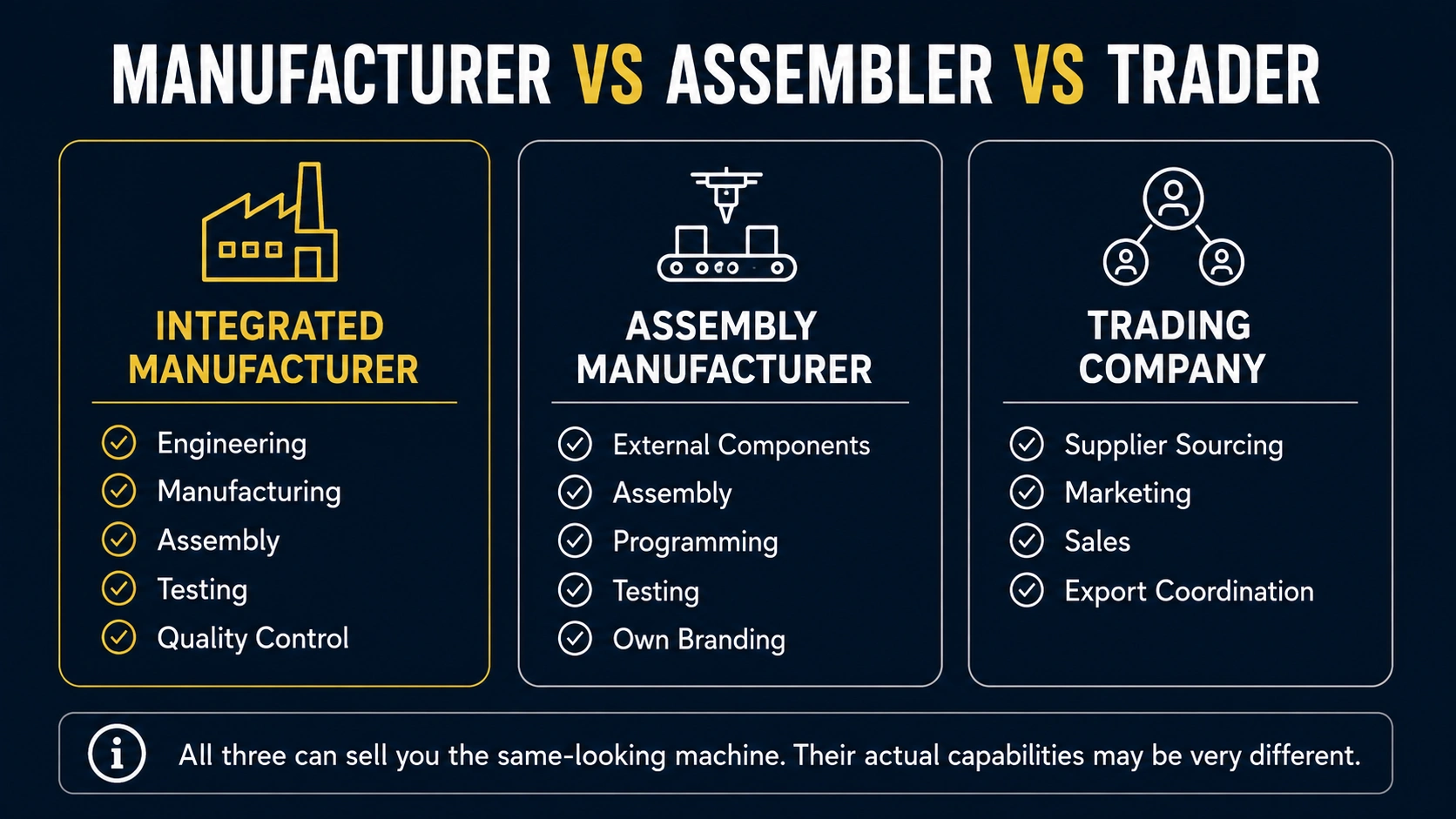
Assembly is not inherently a weakness. Modern machinery manufacturers commonly source motors, bearings, sensors, drives, controllers and other specialized components. The important questions are how components are selected, what engineering is performed internally, how assembly is controlled, how finished performance is tested and who takes responsibility when a problem occurs.
The Chinese supplier that is easiest to find online is not necessarily the supplier best qualified to manufacture the machine. Some capable factories depend more on domestic customers, industry relationships, Chinese platforms, exhibitions and distributor networks than on international digital marketing.
Alibaba and similar platforms can support supplier discovery, but a professional listing should not be treated as a complete verification system.
How do you verify a Chinese machinery supplier?
Supplier verification should combine legal, commercial, physical, technical and operational evidence. No single document or factory photograph proves that a company can deliver the required machine. For a detailed due-diligence workflow, see How to Verify a Chinese Machinery Manufacturer.
- 1Verify the legal entity
Match the Chinese company name, business license, quotation, contract, bank account and export documents.
- 2Confirm the supplier's role
Determine what is manufactured, assembled, programmed, tested or outsourced.
- 3Inspect the factory
Review active production, equipment, employees, assembly, warehousing, quality control and testing.
- 4Validate compliance
Check certificate ownership, issuing body, product scope, validity and destination-market relevance.
- 5Review comparable cases
Look for the same machine category, operating conditions, capacity, industry and export market.
Verify the legal company
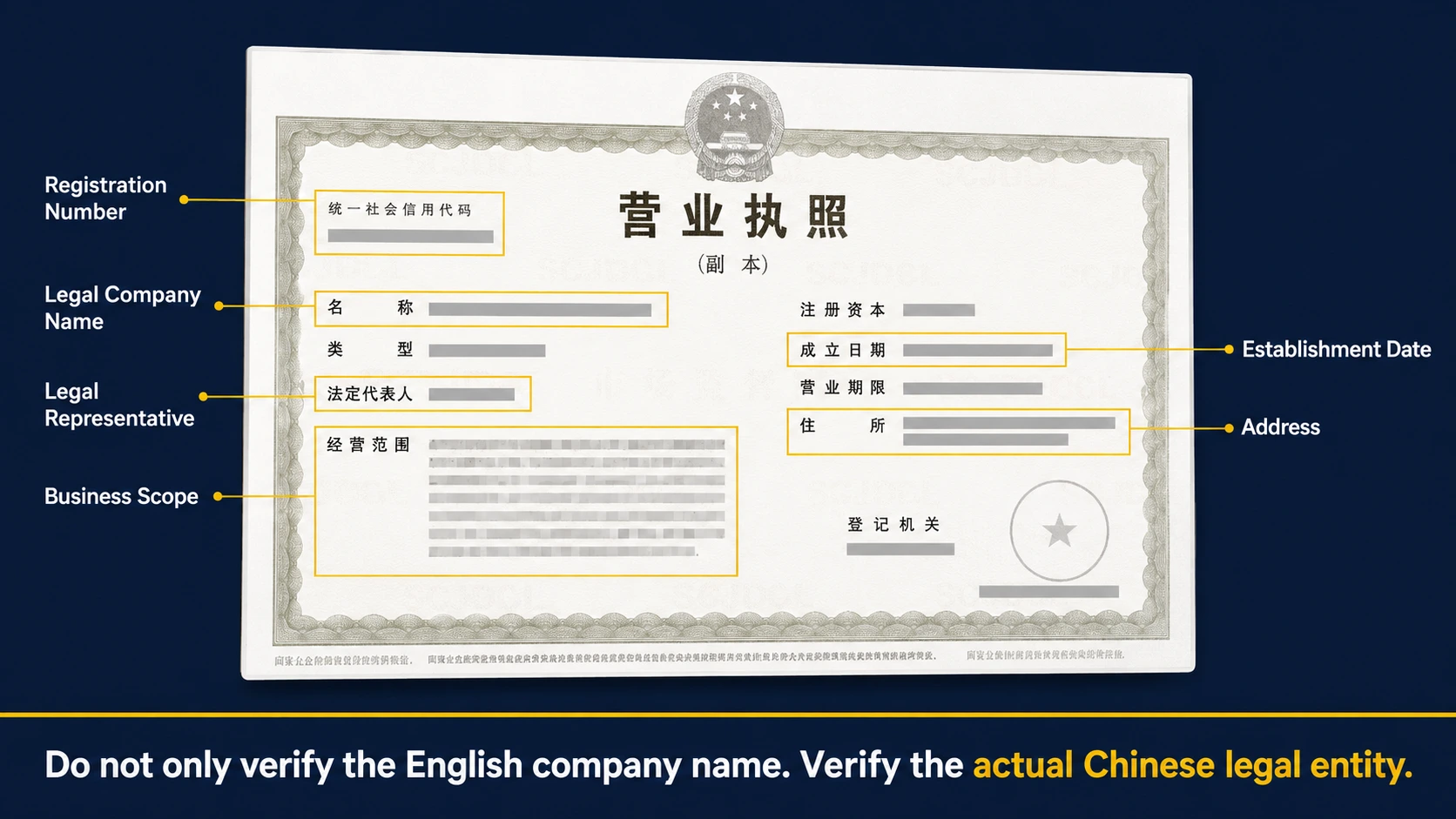
Request the official Chinese business license and confirm the legal name, Unified Social Credit Code, registered address, legal representative, establishment date, business scope and current company status. The company details should remain consistent across the quotation, contract, invoice, beneficiary bank account, certificates and export documentation.
An inconsistency is not always fraud; some manufacturers use related export entities. However, the relationship must be explained and documented before payment.
Verify the factory and current operations
A useful factory visit goes beyond the showroom. It should examine production and assembly areas, engineering resources, component storage, quality-control procedures, testing equipment, machines currently being built and finished equipment awaiting shipment.
Ask the supplier to explain:
- Which processes are performed internally?
- Which components and processes are outsourced?
- What production and testing equipment is available?
- Who owns the factory and production assets?
- Which engineers will approve the offered configuration?
- Can the buyer inspect comparable machines in production?
Verify certificates and customer cases carefully
Receiving a certificate PDF does not establish compliance. Confirm the certificate owner, issuing body, applicable standards, covered product models, validity and relevance to the destination market. Customer cases should also be treated as supporting evidence rather than proof on their own.
Start with a measurable technical RFQ
Price comparisons are meaningful only when suppliers are quoting against the same requirement and scope. Before contacting shortlisted suppliers, convert the application into a technical requirement sheet or RFQ. Use the detailed industrial machinery RFQ guide to structure the application, scope and supplier response.
- Required capacity, output, pressure, flow or cycle time
- Product, material or process handled by the machine
- Voltage, frequency, phase and available electrical supply
- Ambient temperature, humidity, altitude and cooling conditions
- Operating hours, duty cycle and expected production schedule
- Efficiency, noise, safety and destination-market compliance requirements
- Control, automation, PLC, HMI and communication requirements
- Installation boundaries, utilities and site limitations
- Required manuals, drawings, certificates, spare parts and training
- Inspection method, FAT procedure and measurable acceptance criteria
- Warranty scope and after-sales response expectations
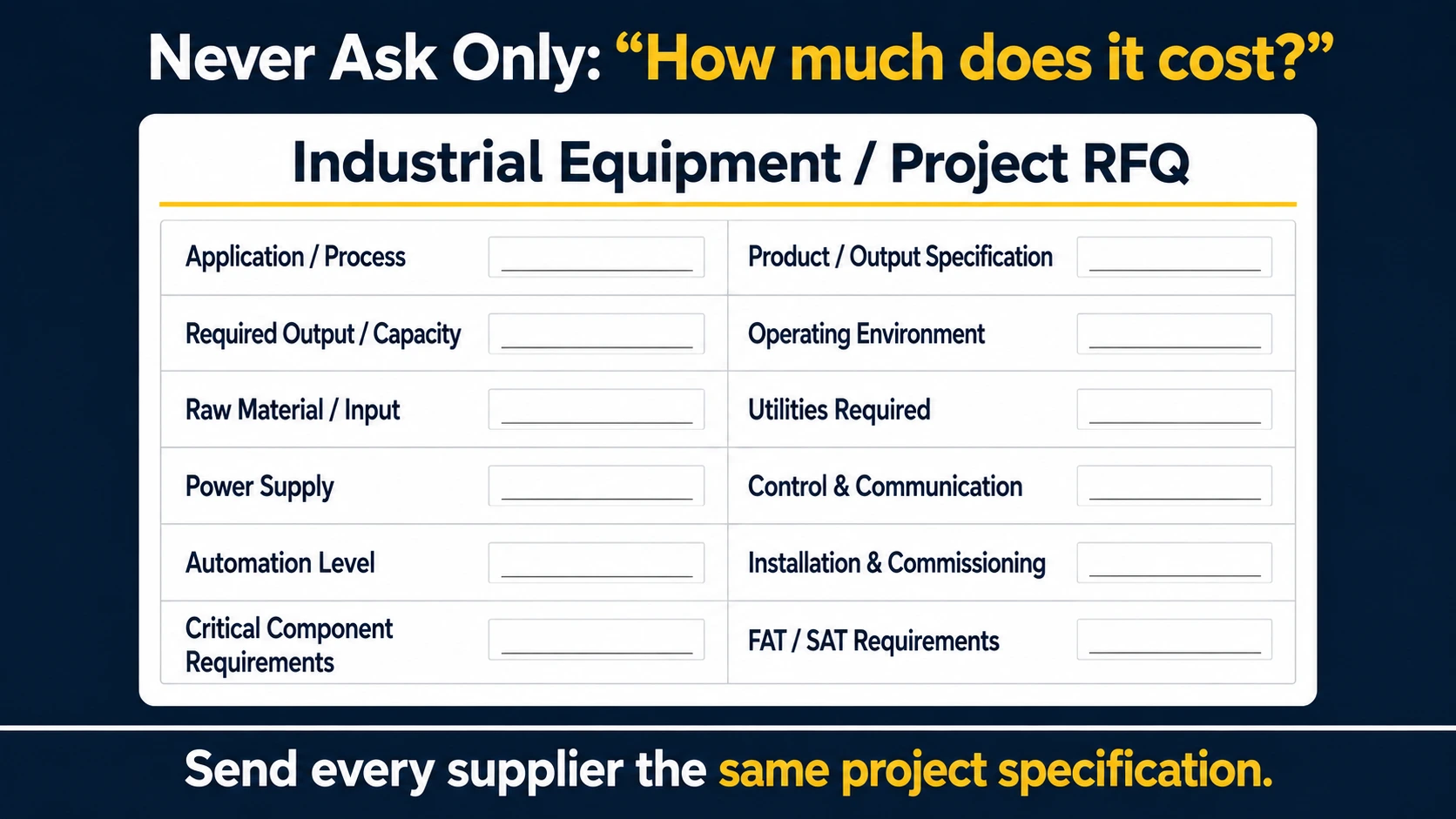
Separate mandatory requirements from preferences. Require suppliers to identify every deviation instead of silently substituting a different configuration. Important promises should appear in the final technical agreement, not only in email or chat messages.
How should machinery quotations be compared?
Never compare industrial machinery using price and model name alone. Two machines with the same stated capacity can use different motors, processing units, heat exchangers, bearings, pumps, sensors, drives, PLCs, safety systems and control logic. The industrial machinery supplier comparison guide provides a structured method for normalizing these differences.
| Comparison layer | Questions to answer |
|---|---|
| Technical performance | Does the offered machine satisfy every mandatory requirement under the stated operating conditions? |
| Critical components | Are brand, model, origin, rating and warranty documented? |
| Scope of supply | What equipment, accessories, utilities, installation work, training and documentation are included or excluded? |
| Testing and acceptance | How will output be measured, with which instruments, under which conditions and against which pass/fail limits? |
| Commercial terms | What are the Incoterm, payment milestones, delivery period, validity and remedies for non-conformance? |
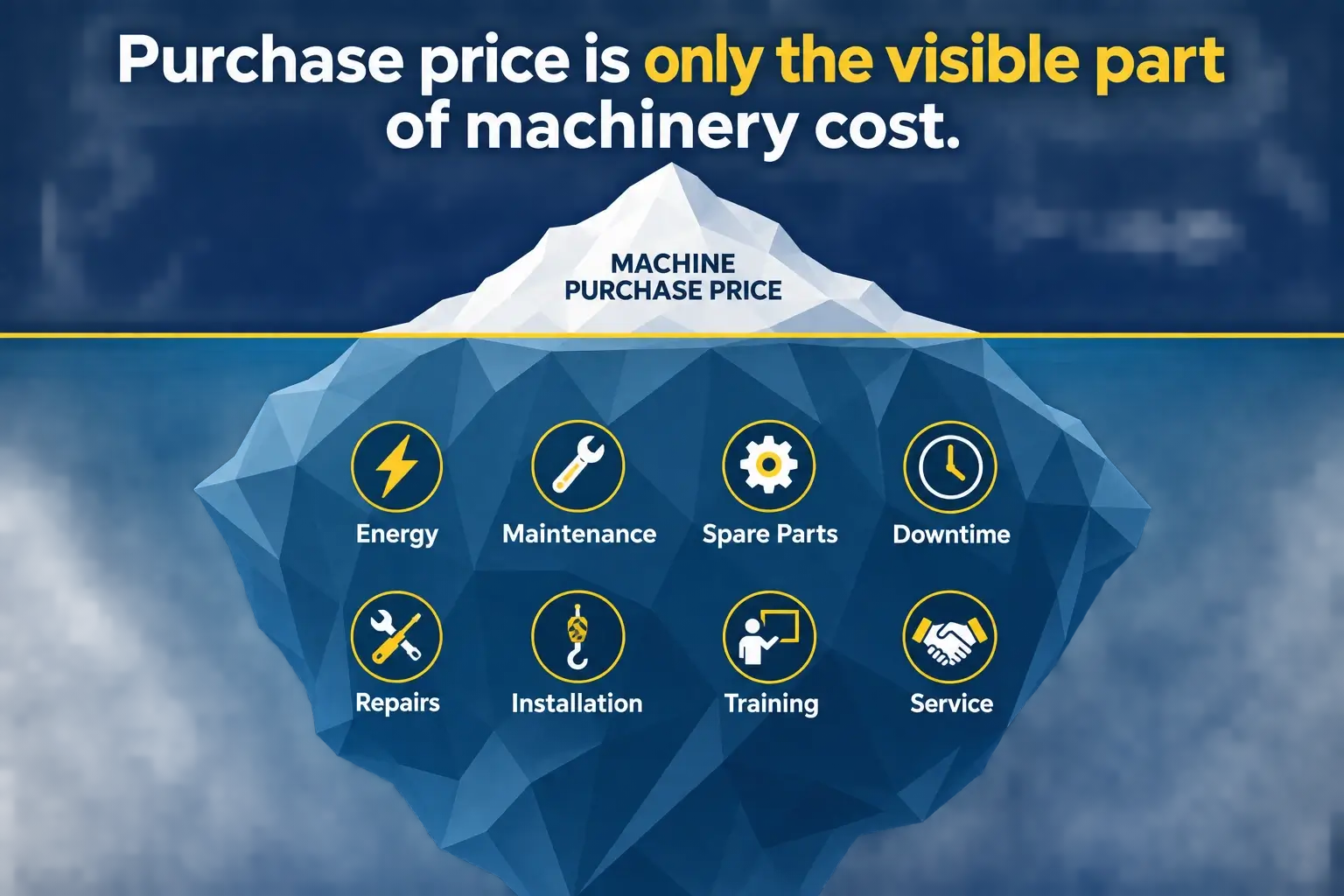
| Life-cycle cost | What are the expected energy, maintenance, consumables, spare-parts, repair and downtime costs? |
| After-sales support | Who provides remote help, replacement parts, PLC backups, field service and warranty support? |
For critical equipment, prepare a component schedule listing the approved brand, model, origin, rating and warranty. Any critical substitution should require written buyer approval.
The lowest purchase price may not produce the lowest total cost. A more expensive machine can be the better commercial choice if it offers higher efficiency, stronger components, easier maintenance, available spare parts and lower downtime risk.
Why measured performance matters more than the display
In one case encountered while working with an industrial equipment manufacturer, a customer requested an 11 kW combined air compressor capable of 16 bar. Under the relevant conditions, the proposed configuration could not genuinely reach the requested pressure; its practical maximum was approximately 15.8 bar.
The displayed controller parameter was adjusted to show 16.0 bar, but an independent pressure test still indicated approximately 15.8 bar. The difference was small, but the lesson was significant: a displayed value does not independently prove physical performance.
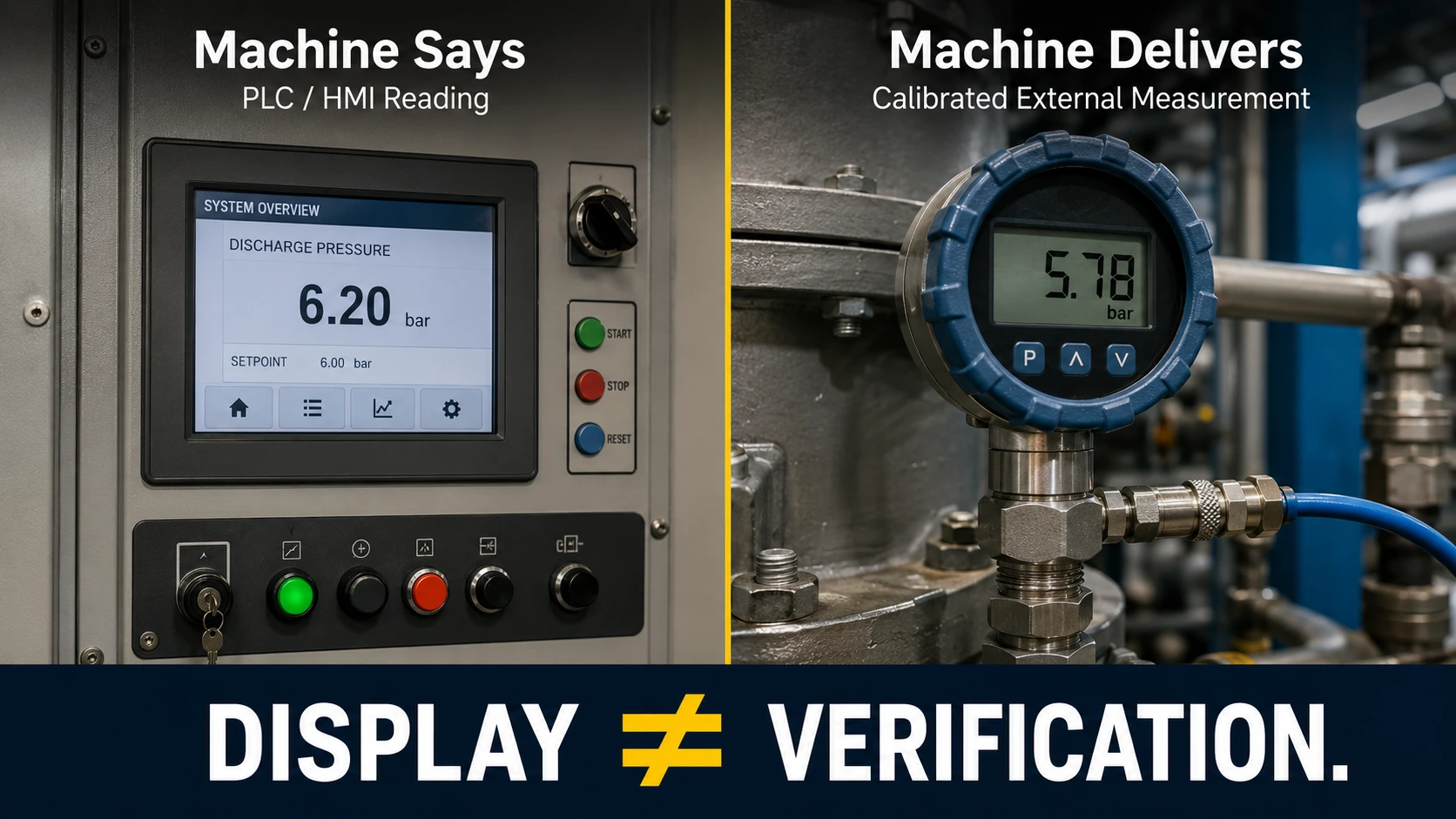
The same principle applies to pressure, flow, temperature, electrical consumption, output, speed, dimensions, cycle time, vibration and tolerances. Define how each acceptance value will be measured, under which conditions, using which instrument and with what allowable tolerance.
A PLC or HMI may show a configured target, scaled sensor value or calculated value. Acceptance should be based on the agreed test procedure and evidence, especially when the parameter is critical to production.
What should be inspected before shipment?
Pre-shipment inspection checks whether the completed machine matches the approved order and is ready for transport. It should be scheduled before final packing, while internal components and identification plates remain accessible. Follow the detailed pre-shipment inspection guide for industrial machinery to plan conformity, component, document and packing checks.
- Workmanship, paint, welding, enclosure, dimensions and labeling
- Machine model, serial number and main nameplate data
- Approved motors, PLCs, drives, bearings, sensors, valves and other critical components
- Electrical cabinet, wiring, safety devices and control-panel configuration
- Startup, operating functions, alarms and agreed performance tests
- Manuals, drawings, electrical diagrams, certificates and PLC or HMI backups
- Included spare parts, accessories, tools and consumables
- Export packaging, moisture protection, fixing, labels and packing list
If the supplier says the machine has already been packed, the inspection has been scheduled too late. The purchasing agreement should allow inspection before final packaging and before shipment authorization.
When is a Factory Acceptance Test needed?
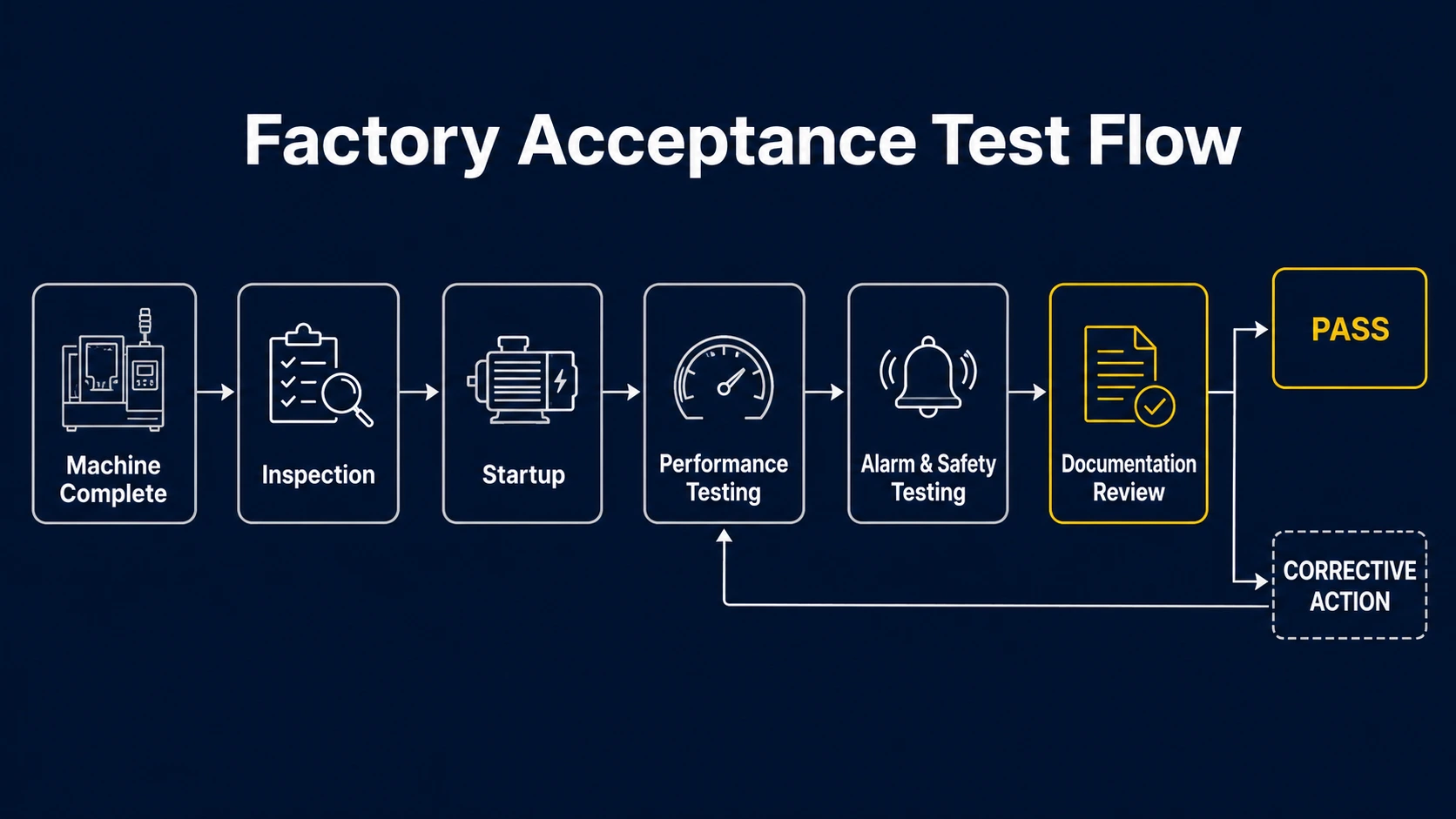
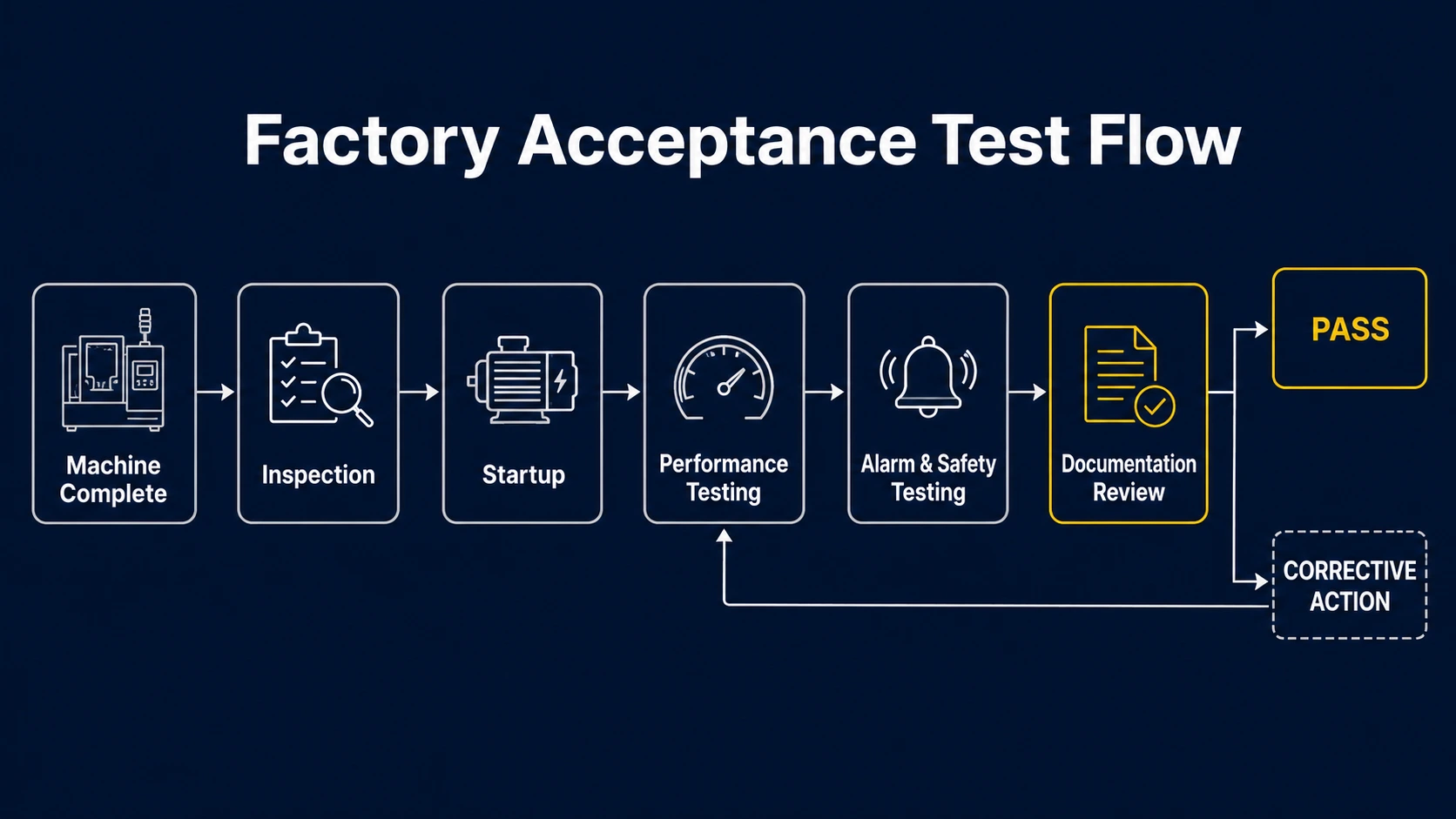
A Factory Acceptance Test is more formal than a general visual inspection. It uses an agreed protocol to demonstrate that the completed equipment satisfies defined functional and performance requirements. The detailed Factory Acceptance Testing guide explains protocol design, witnessing, deviation closure and release.
FAT is particularly valuable for customized, high-value, technically complex or production-critical machinery. The protocol should define the test conditions, instruments, duration, data recorded, witness requirements, pass/fail limits, corrective actions and retest process.
- 1Confirm identity
Match the machine, serial number, configuration and approved component schedule.
- 2Inspect condition
Check workmanship, assembly, electrical systems, safety devices and documentation.
- 3Run functions
Test startup, operating modes, controls, alarms, interlocks and shutdown behavior.
- 4Measure performance
Record the agreed output, capacity, pressure, flow, energy or cycle-time values.
- 5Close deviations
Document failures, corrective actions, responsibilities and required retesting.
- 6Authorize release
Approve packing and shipment only after the agreed acceptance conditions are met.
Step-by-step machinery sourcing process
Professional machinery sourcing is a sequence of controlled decisions rather than a single supplier search.
- 1Define the application
Document the process, operating conditions, required output and site constraints.
- 2Research the market
Build a longlist using several channels rather than relying on one marketplace.
- 3Pre-qualify suppliers
Screen legal identity, relevant experience, factory role and basic technical fit.
- 4Issue a standard RFQ
Send the same measurable requirements and scope to each candidate.
- 5Compare and verify
Evaluate technical compliance, components, price, terms, factory capability and support.
- 6Contract the details
Attach the approved specification, component list, acceptance criteria and remedies.
- 7Follow production
Track milestones, approved changes, component procurement and emerging deviations.
- 8Inspect and test
Complete FAT and pre-shipment inspection before final payment or release.
- 9Ship and commission
Verify packaging and documents, coordinate logistics, installation and training.
- 10Manage support
Maintain documentation, backups, spare-parts contacts and warranty records.

Should you visit factories and trade fairs in China?
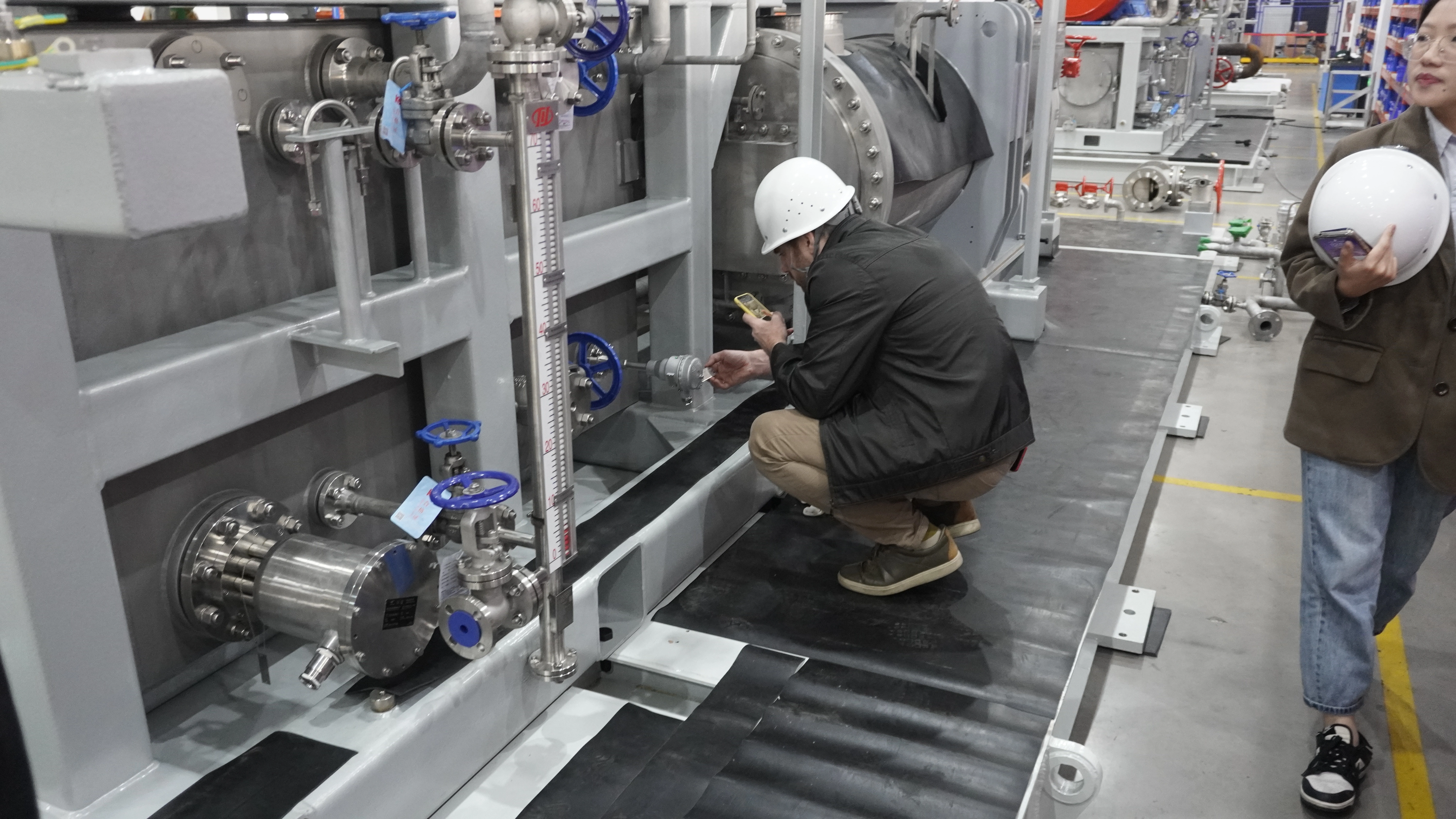
For a significant investment, visiting shortlisted factories can provide evidence that is difficult to obtain remotely. Buyers can meet management and engineers, review machines in production, compare factory systems, examine testing facilities and discuss customization directly. Use the factory visit and trade-fair guide for machinery buyers to prepare the itinerary, audit agenda and follow-up process.
However, a visit is not automatically an audit. A guided showroom tour may reveal little about engineering depth, production control or testing. Prepare a structured agenda, technical checklist and list of documents to collect.
Industrial trade fairs can accelerate supplier discovery and allow rapid comparison across machinery categories. Treat an exhibition meeting as the start of qualification rather than proof that an exhibitor is the right manufacturer.
What are the main warning signs before paying a deposit?
No single warning sign proves that a supplier is unreliable, but several unresolved inconsistencies should stop the purchasing process until they are explained.
- A price materially below comparable offers without a credible technical explanation
- Different company names across the quotation, contract, invoice, certificate or bank account
- Refusal to provide the Chinese business license or explain the contracting entity
- Refusal of a reasonable factory visit, third-party inspection or witnessed test
- Vague specifications, missing deviations or constantly changing technical answers
- Performance claims without a defined test method or suitable measurement evidence
- Pressure to pay a deposit before technical and commercial details are agreed
- Certificates that belong to another entity or do not cover the offered product
- Undocumented component substitutions or unclear scope of supply
- Warranty terms that omit coverage, start date, response process or parts responsibility
Before payment, confirm the legal beneficiary, technical attachments, component schedule, scope of supply, payment milestones, Incoterm, delivery basis, inspection rights, FAT criteria, non-conformance process, warranty and spare-parts responsibilities. Review the complete machinery supplier payment and red-flag checklist before authorizing a deposit or balance.
Why local representation in China can reduce risk
A buyer-side representative in China can support supplier research, local company checks, factory visits, technical communication, quotation comparison, production follow-up, inspection, FAT witnessing, exhibition support and after-sales coordination.
The value comes from evidence, technical coordination and accountability,not merely forwarding messages. The representative should clearly disclose its role, fees and supplier relationships and should protect the buyer's approved requirements.
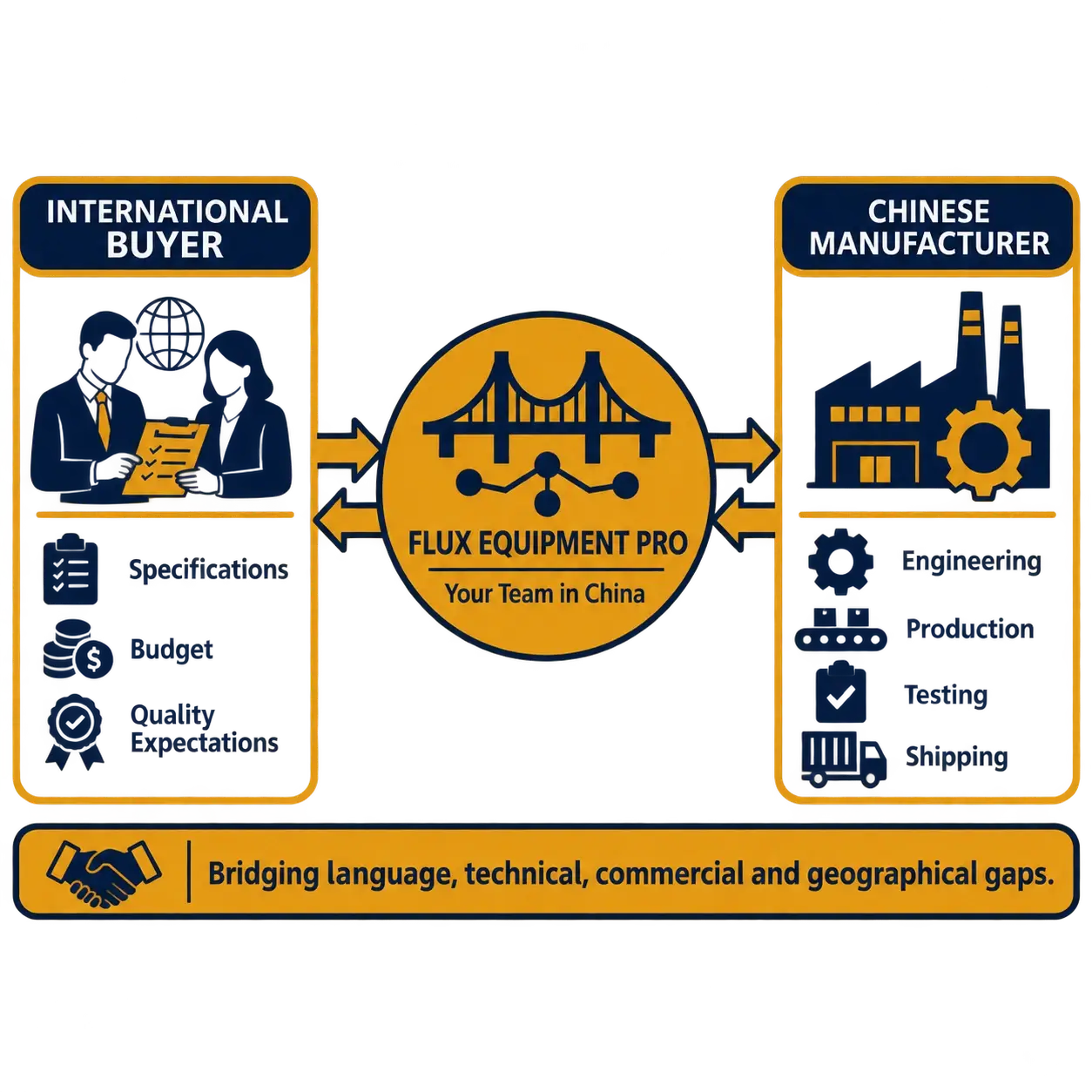
Flux Equipment Pro supports international buyers with manufacturer sourcing, factory verification, supplier comparison, factory visits, production follow-up, inspection, FAT coordination, trade-fair support and after-sales communication.
Final industrial machinery sourcing checklist
- The legal supplier, factory role, contracting entity and payment beneficiary are verified
- The complete technical requirement and approved scope of supply are attached to the agreement
- Critical component brands, models, ratings and substitution controls are documented
- Operating conditions, performance targets, test methods and acceptance limits are defined
- Payment terms, Incoterm, delivery milestones and non-conformance responsibilities are clear
- Inspection and FAT have been completed before final packing and shipment authorization
- Manuals, drawings, electrical diagrams, certificates, backups and spare-parts lists are complete
- Export packaging, identification, packing list and shipping documents are verified
- Warranty coverage, remote support, replacement-parts procedure and service contacts are recorded
The objective is not simply to find the cheapest machine in China. It is to identify the right supplier, define the right equipment, obtain a commercially sound offer, verify the completed machine before shipment and establish support for its operating life.
Frequently asked questions
- Is it safe to buy industrial machinery from China?
- Yes, provided the buyer verifies the supplier, documents measurable technical requirements, agrees inspection and acceptance criteria, and tests the finished machine before shipment. The level of verification should increase with the machine's value, customization and importance to production.
- How can I find reliable Chinese machinery manufacturers?
- Use several discovery channels, create a longlist, send the same technical RFQ to each candidate, and verify the shortlisted companies' legal entities, factories, engineering capabilities, component choices, customer cases and testing processes.
- How can I tell whether a supplier is a manufacturer or a trading company?
- Check the Chinese legal entity, factory address, employees, production equipment, assembly and testing areas, current production activity and the processes performed internally. Do not rely only on a salesperson's statement or an online listing.
- Should industrial machinery be inspected before shipment?
- Pre-shipment inspection is strongly recommended for expensive, customized or production-critical machinery. It should take place before final packing and before the buyer authorizes the remaining payment or shipment.
- What is a Factory Acceptance Test?
- A Factory Acceptance Test, or FAT, is a documented test performed before shipment to confirm that machinery meets the agreed technical, functional, safety and performance acceptance criteria.
- Should I visit Chinese machinery factories before buying?
- A factory visit is valuable for significant investments because it can reveal production, engineering, quality-control and testing capabilities. A visit is most effective when the buyer arrives with a structured audit plan and technical questions.
- Do I need a sourcing partner in China?
- Not for every purchase. Local representation is most valuable when equipment is expensive, customized or production-critical and requires factory verification, technical coordination, production follow-up, inspection or after-sales communication.
Request help sourcing industrial machinery from China
If you are planning to purchase industrial machinery, production equipment or other B2B equipment from China, share the application, technical requirements, quantity and destination. Flux Equipment Pro can help evaluate the supplier market and coordinate the sourcing and verification process.
Source industrial machinery from China with confidence
Tell us what machine you need, its technical requirements, quantity and destination country.