
Pruebas de aceptación en fábrica de maquinaria industrial
Aprenda a planificar y realizar una prueba de aceptación en fábrica para maquinaria industrial, incluidos protocolos, instrumentos, pruebas funcionales, pruebas de rendimiento, desviaciones y autorización de envío.
Forma parte de Cómo comprar maquinaria industrial en China: guía completa

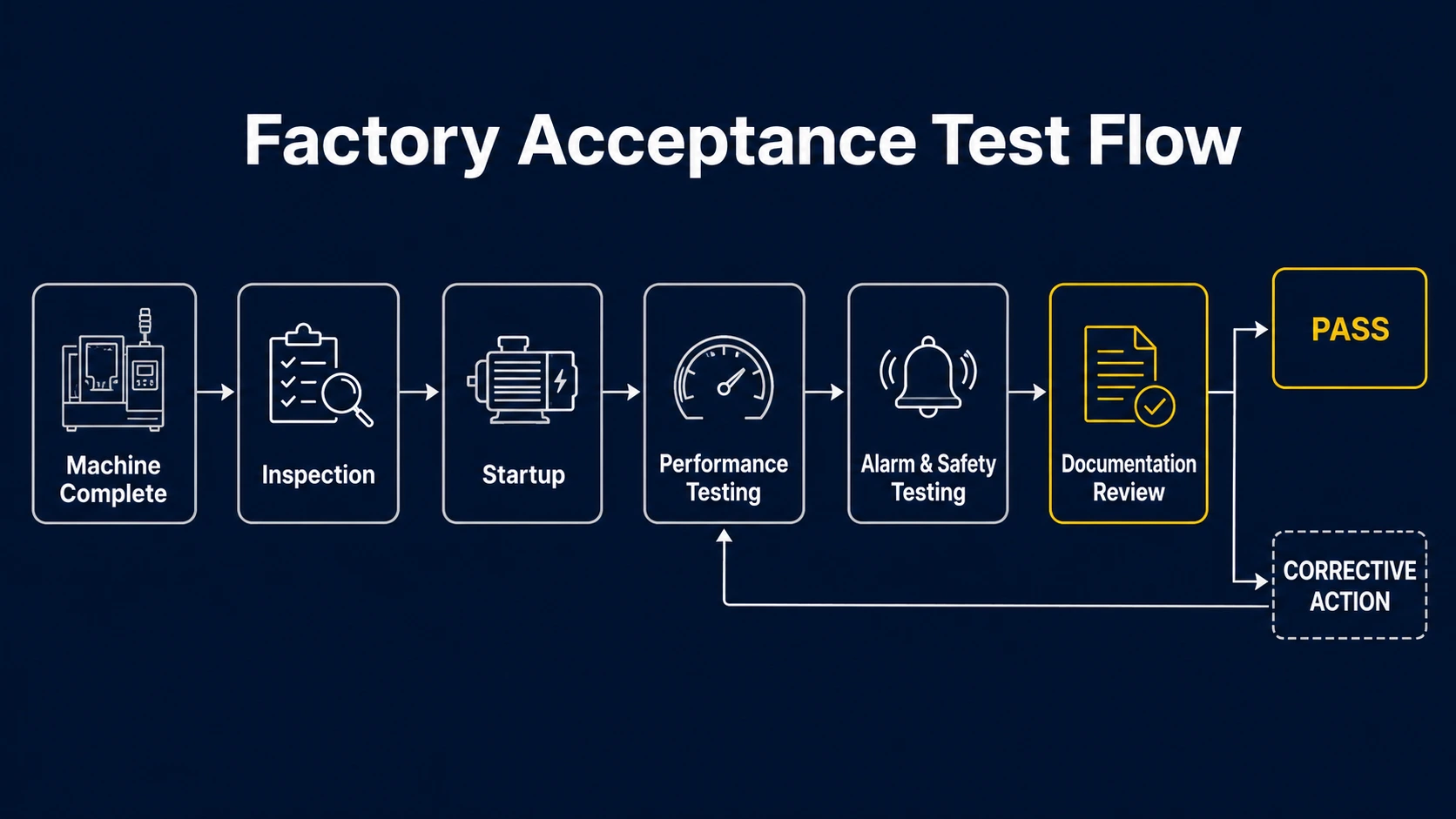
A Factory Acceptance Test is the buyer's opportunity to evaluate completed machinery while it remains at the supplier's facility and can still be corrected before international shipment.
FAT is most valuable for customized, high-value, technically complex or production-critical equipment. It does not replace supplier quality control, factory verification, pre-shipment inspection or site commissioning. It creates a formal evidence-based decision point between production completion and shipment.
Place the FAT requirement in the industrial machinery RFQ and connect it to the wider machinery sourcing process.
What is the purpose of FAT?
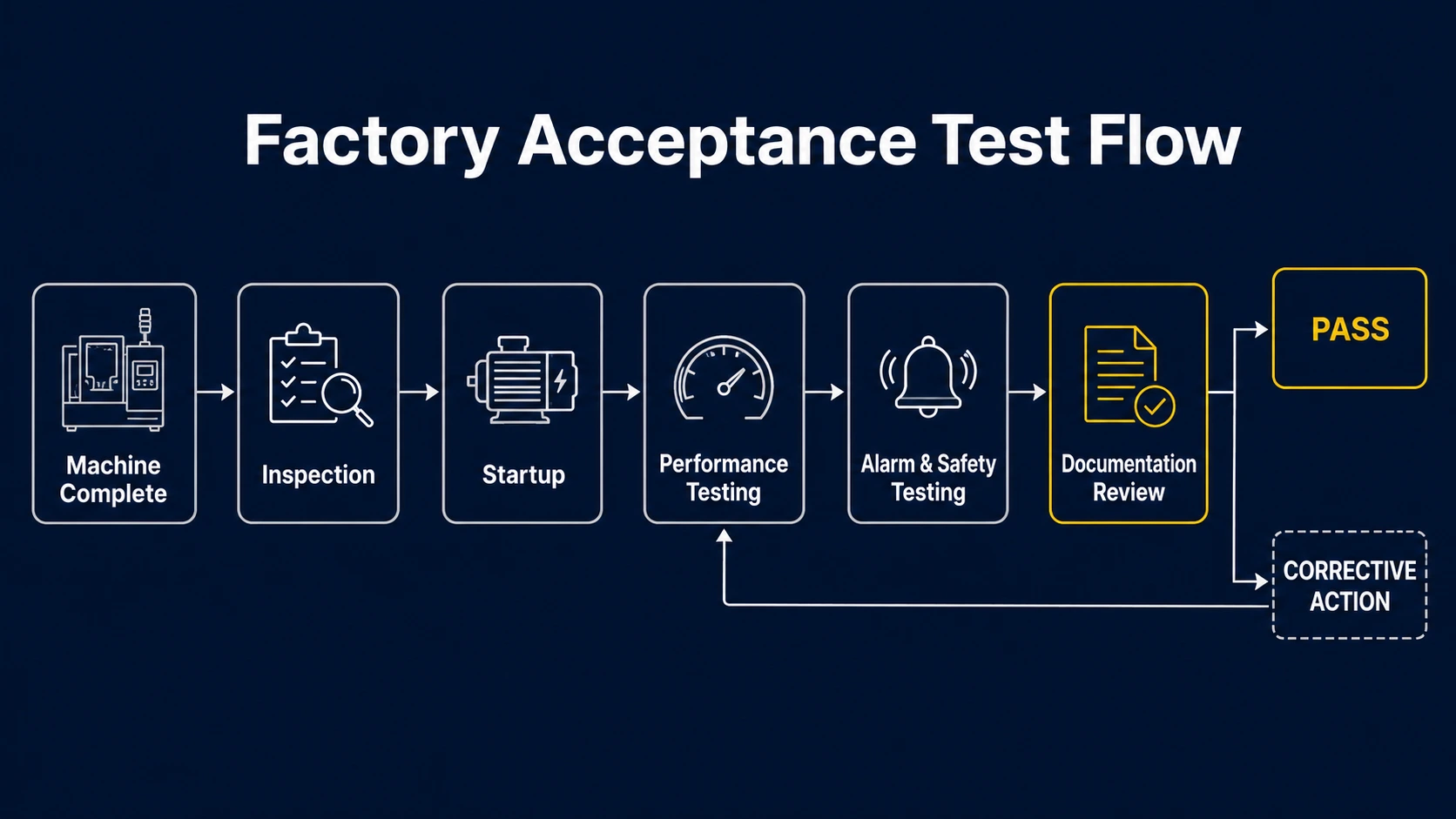
FAT provides evidence that the machine supplied matches the approved project and performs the functions that can reasonably be tested at the factory.
- Confirm machine identity and approved configuration
- Check assembly, controls and safety-related functions
- Demonstrate operating modes, alarms and interlocks
- Measure agreed performance under stated conditions
- Review documents, software backups and test records
- Identify and close deviations before shipment
- Create an approval record for packing and release
FAT, inspection and site acceptance: what is the difference?
| Activity | Primary focus | Typical timing |
|---|---|---|
| Supplier final test | Factory's routine quality and production release | Before buyer acceptance activities |
| Pre-shipment inspection | Identity, quantity, workmanship, components, documents and packing readiness | Before final packing or shipment |
| Factory Acceptance Test | Contractual functions and measured performance | After completion and before shipment release |
| Site Acceptance Test | Installed operation, interfaces and site-dependent performance | After installation and commissioning |
The activities can overlap, but the protocol should state which requirement is being accepted at each stage.
Step 1: Define the FAT during procurement
The RFQ should identify required tests, witness rights, supplier preparation, test materials, instruments, reports, pass-or-fail criteria and responsibility for correction and retest.
If full-load conditions cannot be created at the factory, agree what will be demonstrated through partial testing, calculation, certified component evidence or later site testing. Do not discover this limitation on FAT day.
Step 2: Approve the detailed FAT protocol
The protocol should translate the technical agreement into executable test cases.
| Protocol field | Required detail |
|---|---|
| Requirement reference | Contract or specification clause being verified |
| Preconditions | Machine state, utilities, material, environment and stabilization |
| Procedure | Actions, operating point, sequence and duration |
| Measurement | Instrument, location, range, accuracy and calculation |
| Acceptance | Target, tolerance and pass-or-fail rule |
| Record | Data, photograph, video, printout or signed observation retained |
Assign responsibilities and expected attendees. The supplier should run an internal pre-FAT so the buyer's witness event is not used for basic debugging.
Step 3: Confirm readiness before travel or remote witnessing
Request readiness confirmation, machine photographs, open-item list, proposed schedule, instrument list and the current protocol revision. Confirm that utilities, test material, operators and responsible engineers will be available.
For remote FAT, agree camera coverage, live data access, continuous views where needed, document sharing and how the witness can request repeated or spontaneous checks.
Recorded clips can support evidence but do not provide the same control as a live, traceable test performed against the approved protocol.
Step 4: Verify machine and instrument identity
Before operating the equipment, record model, serial number, nameplate data, software or program revision and controlled critical components. Confirm that the tested machine is the machine intended for shipment.
Review instrument identification and calibration status appropriate to the measurement risk. Check measurement location and range; an accurate instrument in the wrong location can still produce an invalid result.
Step 5: Inspect condition and assembly
Examine workmanship, guarding, electrical cabinet, wiring, labels, lubrication, fluid systems, fasteners, access and visible components. Review unresolved production deviations before starting performance tests.
FAT should not proceed as if a visual defect is irrelevant merely because the machine can run. Record each issue according to the project's classification system.
Step 6: Test functions, controls and safety-related behavior
- Startup, normal operation and controlled shutdown
- Manual, automatic, local and remote modes where applicable
- Setpoint entry, recipes and user permissions
- Sensors, actuators and direction of operation
- Alarms, warnings and event history
- Interlocks and permissive conditions
- Emergency-stop response and restart behavior
- Communication signals and required interfaces
- Loss and restoration of power or utilities where safely testable
- PLC and HMI backup and version identification
Safety testing must follow an approved safe method. Do not bypass protection casually to demonstrate a fault.
Step 7: Measure performance
Performance tests should reflect the guaranteed parameters: output, pressure, flow, cycle time, accuracy, temperature, vibration, energy or other project-specific values.
- 1Stabilize
Reach the defined operating condition before recording results.
- 2Measure
Use the approved instruments, locations and sampling interval.
- 3Record
Capture raw data, conditions, settings and machine identity.
- 4Calculate
Apply agreed conversions, corrections and averaging rules.
- 5Judge
Compare the result with the contractual tolerance and limit.
Do not confuse an HMI setpoint or scaled value with independent proof. Where a parameter is critical, use the measurement method agreed in the protocol.
Step 8: Review documents and deliverables
Confirm the presence and revision of drawings, manuals, electrical diagrams, component lists, certificates, test reports, spare-parts lists and software backups. A machine can pass its operating test while the project remains incomplete because essential documentation is missing.
Step 9: Classify deviations and manage retesting
Use clear categories such as critical, major and minor, defined by the project. Each deviation record should include the requirement, observation, evidence, owner, due date, corrective action and required verification.
State which items block shipment, which require remote documentary closure and which may be completed at site. Approval authority should be explicit.
Corrected performance or functional failures should be retested under the original approved conditions unless a documented change is accepted.
Step 10: Issue the FAT report and release decision
The final report should include attendees, date, location, machine identity, protocol revision, instruments, conditions, results, evidence, deviations and signatures or approvals.
Possible outcomes include passed, conditionally passed with defined open items, or failed pending correction and retest. Link the release decision to the payment and shipment terms already agreed.
Common FAT mistakes
- Writing the protocol after production is complete
- Testing a different configuration or unidentified machine
- Using undefined test conditions or unverified instruments
- Demonstrating setpoints instead of measuring output
- Skipping alarms, interlocks and abnormal conditions
- Allowing the supplier to control all evidence without witness input
- Leaving deviations verbal or without retest requirements
- Authorizing shipment before critical failures are closed
- Assuming FAT replaces site commissioning and acceptance
FAT completion checklist
- The tested machine identity matches the order
- The approved configuration and critical components are present
- All planned functional and performance tests were completed
- Raw data and test conditions are retained
- Results satisfy the agreed acceptance limits
- Critical and major deviations are corrected and retested
- Required documents, backups and spares are accounted for
- The signed report states the release status clearly
- Remaining site tests and responsibilities are documented
Frequently asked questions
- What is a Factory Acceptance Test for industrial machinery?
- A Factory Acceptance Test, or FAT, is a documented pre-shipment test performed at the supplier's facility to confirm machine identity, configuration, functions, safety-related behavior and agreed performance against approved acceptance criteria.
- When should the FAT protocol be written?
- The FAT requirements should be defined in the RFQ and contract, then converted into a detailed protocol and approved before testing. Writing acceptance criteria after the machine is complete creates disputes and weakens leverage.
- Who should attend a machinery FAT?
- Attendance depends on risk and complexity. It may include supplier engineering and quality staff, the buyer's technical team, an independent inspector, system specialists and sometimes the end user's operators or consultant.
- Does passing FAT prove the machine will work at site?
- FAT reduces risk but cannot reproduce every site condition. Site installation, utilities, product, integration and commissioning may require separate Site Acceptance Testing or performance validation.
- What happens if machinery fails FAT?
- Record the deviation, evidence, requirement, responsible party, corrective action and retest method. Shipment release should wait until critical failures are corrected and the agreed acceptance process is satisfied.
- Is FAT the same as pre-shipment inspection?
- No. FAT focuses on documented functional and performance acceptance, while pre-shipment inspection also covers quantity, workmanship, components, documents, accessories, identification and packaging. They may be coordinated in one visit but require distinct checklists.
Request FAT coordination in China
Flux Equipment Pro can help review FAT protocols, coordinate factory readiness, witness machinery tests and document deviations before shipment release.
Plan a Factory Acceptance Test
Share the machine specification, supplier, project stage and proposed acceptance requirements.
Seguir leyendo
 Visitas a fábricas y ferias comercialesPlanifique eficazmente visitas a fábricas de maquinaria y reuniones en ferias de China mediante la precalificación de proveedores, agendas técnicas, listas de verificación de fábrica y seguimiento estructurado.Leer: Visitas a fábricas y ferias comerciales
 Inspección previa al envío de maquinaria industrialGuía práctica para inspeccionar maquinaria industrial antes del envío, incluida la identidad de la máquina, fabricación, componentes, funciones, documentos, no conformidades y embalaje de exportación.Leer: Inspección previa al envío de maquinaria industrial
 Cómo comparar proveedores de maquinaria industrialCompare proveedores de maquinaria industrial según conformidad técnica, componentes, alcance, pruebas, condiciones comerciales, coste del ciclo de vida y servicio posventa, no solo por precio.Leer: Cómo comparar proveedores de maquinaria industrial