
كيفية إعداد طلب عرض أسعار للمعدات الصناعية
تعرف على كيفية إعداد طلب عرض أسعار للمعدات الصناعية يشمل متطلبات التطبيق، والأداء، وظروف التشغيل، والمكونات، ونطاق التوريد، والاختبارات، والمستندات، وانحرافات المورد.
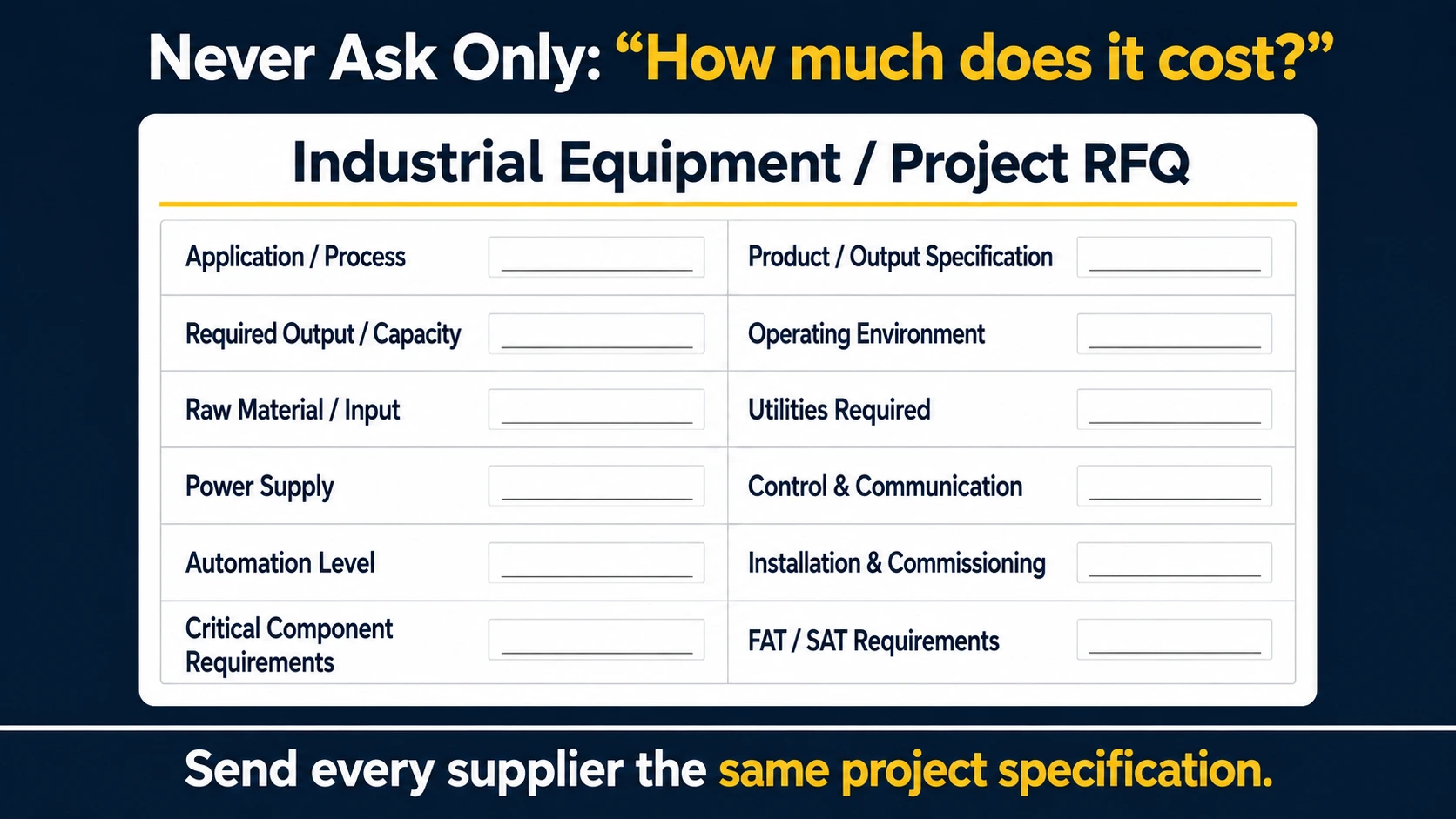

An industrial machinery request for quotation, or RFQ, is more than a request for price. It is the document that tells suppliers what problem must be solved, under which conditions, what must be included and how the finished machine will be accepted.
Weak RFQs produce offers that look comparable but describe different equipment. One supplier may include installation, commissioning and spare parts while another excludes them. One may rate output under ideal conditions while another accounts for temperature, altitude or duty cycle. A clear RFQ exposes those differences before a purchasing decision.
This guide focuses on preparing the RFQ. For the complete purchasing workflow, see How to Source Industrial Machinery from China, and verify shortlisted companies using the Chinese machinery manufacturer verification guide.
What is an industrial machinery RFQ?
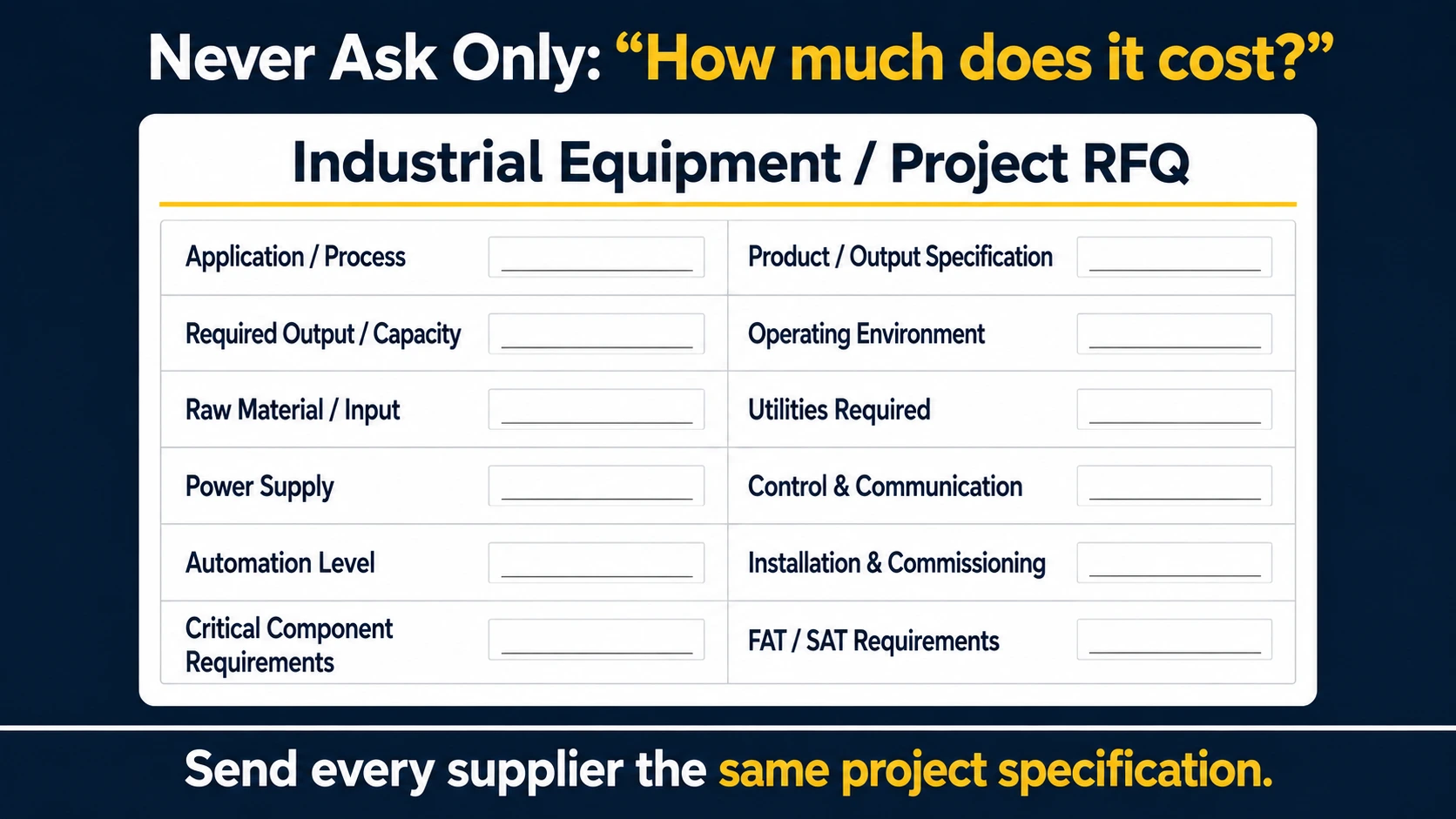
An industrial machinery RFQ is a controlled package used to obtain technical and commercial offers from qualified suppliers. It normally contains the buyer's instructions, application description, technical specification, scope boundaries, quotation format and contractual expectations.
| Document | Primary purpose | Typical content |
|---|---|---|
| User requirement | Explain the operational need | Process, production target, constraints and business objective |
| Technical specification | Define measurable machine requirements | Performance, environment, utilities, interfaces, controls, safety and acceptance |
| RFQ | Request comparable supplier offers | Technical specification plus scope, pricing, schedule, terms and response instructions |
| Technical agreement | Record the final approved configuration | Clarifications, deviations, drawings, component schedule and acceptance criteria |
The RFQ is not necessarily the final contract, but its controlled requirements should flow into the final technical agreement and purchase documents.
Step 1: Define the application before the machine
Describe what enters the process, what transformation occurs and what acceptable output must leave it. Include the product or material, relevant physical properties, upstream and downstream equipment, production schedule and consequences of interruption.
Avoid beginning only with a motor power or supplier model. Two machines with the same nominal power may deliver different performance, efficiency or durability. The application gives suppliers the information needed to size the system responsibly.
- Product, material, fluid or gas handled by the machine
- Required process and desired finished result
- Target production rate, capacity, flow, pressure or cycle time
- Minimum, normal and maximum operating points
- Daily operating hours, annual schedule and duty cycle
- Upstream and downstream equipment and interface conditions
- Existing bottleneck or reason for purchasing the machine
- Critical consequences of underperformance or downtime
Step 2: State measurable performance requirements
Separate mandatory requirements from preferences. A mandatory value determines acceptance; a preference may support supplier optimization.
For each critical parameter, define the unit, reference conditions and permitted tolerance. Pressure without identifying gauge or absolute basis, flow without reference conditions, or production capacity without defining the input material can create major errors.
A catalog rating or configured PLC setpoint does not prove delivered performance. State how the result will be measured on the finished machine and under which conditions.
Step 3: Document site and operating conditions
Environmental and utility conditions can change machine selection. Provide ambient temperature range, humidity, altitude, dust or corrosive exposure, indoor or outdoor location and hazardous-area classification where applicable.
State the available electrical supply, cooling water, compressed air, steam, gas, drainage, ventilation and foundation limitations. Include voltage tolerance, frequency, phase and earthing arrangement rather than only the nominal voltage.
| Condition | Why it matters |
|---|---|
| Ambient temperature | Cooling capacity, component ratings and control-panel design |
| Altitude | Motor cooling, air density, combustion and compressor performance |
| Humidity or dust | Enclosure protection, filtration, corrosion and electrical reliability |
| Voltage and frequency | Motor speed, component compatibility and control architecture |
| Cooling-water quality and temperature | Heat-exchanger sizing, fouling and discharge temperature |
| Space and access | Machine dimensions, maintenance clearance, lifting and installation sequence |
Step 4: Define the scope of supply
Write clear boundaries around what the supplier must include. The core machine may require dryers, tanks, conveyors, pumps, filters, tooling, electrical cabinets, cables, piping, foundations, software, accessories or commissioning services before it can operate.
Ask suppliers to divide the offer into included supply, optional supply, recommended supply and buyer responsibility. Require quantities and model details instead of accepting phrases such as “standard accessories included.”
Step 5: Specify critical components and substitution rules
Where component choice affects performance, maintenance or local availability, request the brand, model, origin, rating and warranty. Focus on critical items rather than prescribing every fastener.
Examples include motors, bearings, processing units, PLCs, HMIs, drives, sensors, pumps, valves, safety devices and heat exchangers. State whether named brands are mandatory, approved equivalents are allowed or suppliers may propose alternatives.
Any post-order substitution of a controlled component should require written approval and an explanation of technical equivalence.
Step 6: Define controls, automation and data requirements
Describe operating modes, recipes, user levels, alarms, interlocks, emergency behavior, remote access and required communication protocols. If integration is required, identify the plant system, signal list, network ownership and responsibility for programming or commissioning.
Request source files, parameter lists, PLC and HMI backups, passwords or access arrangements that the buyer is contractually entitled to receive. Clarify cybersecurity and remote-support rules with the plant's responsible specialists.
Step 7: Include safety and compliance requirements
Identify the destination country, intended use and any standards or regulations the machine must satisfy. Do not request “CE” or another marking as a vague checkbox; specify the applicable expectation, required documentation and responsible party.
Safety requirements may include guarding, emergency stops, lockout provisions, pressure protection, electrical protection, warning labels, noise limits and risk-assessment documentation. Obtain qualified advice where legal compliance is critical.
Step 8: List required documents, training and spare parts
- General arrangement and foundation drawings
- Process, piping, pneumatic or hydraulic diagrams where applicable
- Electrical schematics and terminal information
- Operating and maintenance manuals in the agreed language
- Component data sheets and approved component schedule
- Certificates, declarations and test reports required by the project
- PLC and HMI backups plus parameter lists where contractually included
- Recommended commissioning, two-year and critical spare-parts lists
- Preventive-maintenance schedule and consumables list
- Packing list, identification records and shipping documents
Define the expected training audience, location, duration, language, practical content and materials. For commissioning, state which party supplies technicians, tools, utilities, lifting, travel and accommodation.
Step 9: Write the inspection and acceptance criteria
Acceptance requirements should be agreed before production begins, not after the machine is complete.
- 1Identify the parameter
Output, pressure, flow, cycle time, energy, temperature, accuracy or another critical result.
- 2Define test conditions
Input material, utilities, environment, operating point, stabilization and test duration.
- 3Define measurement
Instrument, location, calibration expectation, sampling and calculation method.
- 4Set acceptance limits
Target, tolerance, pass-or-fail threshold and treatment of uncertainty.
- 5Set correction rules
Reporting, corrective action, retest, delay and release responsibilities.
Clarify whether the supplier will perform routine testing, a witnessed Factory Acceptance Test, an independent pre-shipment inspection or all three. Reserve shipment release until required deviations are closed.
Step 10: Standardize the supplier response
Require each supplier to return the same schedules:
- Clause-by-clause compliance statement
- Complete technical data sheet
- Mandatory deviation list
- Critical component schedule
- Included, optional and excluded scope
- Utility consumption and installation requirements
- Delivery schedule with key milestones
- Itemized pricing and Incoterm
- Payment proposal
- Warranty and after-sales response
- Quotation validity and assumptions
Instruct suppliers to mark each requirement as compliant, deviating or not applicable. Any unlisted deviation should not be treated as automatically accepted.
Common industrial machinery RFQ mistakes
| RFQ mistake | Likely consequence | Better approach |
|---|---|---|
| Requesting only price and model | Offers with different performance and scope | Issue one measurable requirement to every supplier |
| Copying one supplier's data sheet | Specification unintentionally favors or repeats its assumptions | Start with the buyer's real application |
| Missing operating conditions | Incorrect sizing or unexpected derating | State environment, utilities and duty cycle |
| No deviation schedule | Differences remain hidden in sales correspondence | Require clause-by-clause compliance |
| Vague testing language | A startup demonstration is presented as acceptance | Define measured pass-or-fail criteria |
| Undefined scope boundaries | Extra costs appear during installation | List supplier and buyer responsibilities |
Final RFQ review checklist
- The application and operating objective are clear
- Every critical performance value has units and reference conditions
- Site environment and available utilities are documented
- Mandatory requirements are separated from preferences
- Scope boundaries, interfaces and buyer responsibilities are defined
- Critical components and substitution rules are stated
- Controls, safety, documentation, training and spare parts are covered
- Inspection and acceptance criteria are measurable
- Suppliers must provide compliance and deviation schedules
- The same controlled RFQ will be sent to every shortlisted supplier
After receiving offers, use a structured industrial machinery supplier comparison rather than relying on the suppliers' preferred quotation layouts. Preserve approved clarifications and deviations in the signed technical agreement.
Frequently asked questions
- What should an industrial machinery RFQ include?
- An industrial machinery RFQ should define the application, required performance, operating conditions, utilities, materials, control and safety requirements, scope of supply, documentation, testing and acceptance criteria, delivery basis, warranty and a mandatory supplier deviation list.
- What is the difference between an RFQ and a technical specification?
- The technical specification defines what the machine must do and the conditions it must satisfy. The RFQ packages that specification with commercial instructions so suppliers can submit complete, comparable offers.
- Should I specify a machine model in an RFQ?
- Only when the model is genuinely required. Otherwise define the application and measurable output, then let qualified suppliers propose a configuration while requiring them to explain assumptions and deviations.
- How detailed should machinery acceptance criteria be?
- Each critical criterion should state the measured parameter, test conditions, instrument or method, duration where relevant, allowable tolerance and pass-or-fail limit. Avoid relying only on a controller display or general statement that the machine runs normally.
- Should suppliers be allowed to propose alternatives?
- Yes, when alternatives are clearly separated from the compliant base offer. Require the supplier to identify every deviation and explain the technical, commercial and operational effect.
- When should the RFQ be finalized?
- Issue a controlled RFQ before requesting final quotations, then incorporate approved clarifications, supplier deviations and acceptance criteria into the signed technical agreement before paying a deposit.
Request support preparing a machinery RFQ
Flux Equipment Pro can help convert your application, operating conditions and project constraints into a structured RFQ suitable for Chinese machinery suppliers.
Prepare your industrial machinery RFQ
Share the application, target performance, destination and available technical information.
تابع القراءة
 زيارات المصانع والمعارض التجاريةخطط بفعالية لزيارات مصانع المعدات والاجتماعات في المعارض داخل الصين باستخدام التأهيل المسبق للموردين، والجداول الفنية، وقوائم التحقق من المصنع، والمتابعة المنظمة.اقرأ: زيارات المصانع والمعارض التجارية
 فحص المعدات الصناعية قبل الشحندليل عملي لفحص المعدات الصناعية قبل الشحن، بما يشمل هوية الآلة، وجودة التصنيع، والمكونات، والوظائف، والمستندات، وحالات عدم المطابقة، وتغليف التصدير.اقرأ: فحص المعدات الصناعية قبل الشحن
 كيفية مقارنة موردي المعدات الصناعيةقارن موردي المعدات الصناعية بناءً على المطابقة الفنية، والمكونات، ونطاق التوريد، والاختبارات، والشروط التجارية، وتكلفة دورة الحياة، وخدمة ما بعد البيع، وليس السعر فقط.اقرأ: كيفية مقارنة موردي المعدات الصناعية