
فحص المعدات الصناعية قبل الشحن
دليل عملي لفحص المعدات الصناعية قبل الشحن، بما يشمل هوية الآلة، وجودة التصنيع، والمكونات، والوظائف، والمستندات، وحالات عدم المطابقة، وتغليف التصدير.


Pre-shipment inspection is the final opportunity to identify visible and verifiable non-conformities while industrial machinery remains at the supplier's factory. Once equipment is packed, shipped and installed abroad, correction becomes slower, more expensive and more disruptive.
Inspection does not guarantee lifetime reliability, and it cannot replace a properly designed Factory Acceptance Test. It confirms that the equipment presented for shipment matches the approved order and release requirements.
For the full purchasing sequence, see How to Source Industrial Machinery from China.
What should pre-shipment inspection achieve?
- Confirm the inspected machine is the ordered machine
- Verify quantity, models, serial numbers and nameplates
- Check workmanship, assembly and visible condition
- Confirm controlled critical components
- Test agreed functions that are within the inspection scope
- Review documents, spares, accessories and tools
- Record and classify non-conformities
- Verify export packing, protection, labels and packing list
- Create evidence for payment and shipment release
When should machinery inspection be scheduled?
Schedule the main inspection when production and supplier internal testing are complete but before final packing. Ask the supplier to confirm readiness with machine identity, completion status and an open-item list.
An inspection conducted too early finds unfinished work. An inspection conducted after crating cannot examine internal components, wiring, fasteners, paint or identification adequately.
- 1Supplier completion
Production and internal quality checks are complete.
- 2Buyer inspection
Identity, conformity, workmanship, components, functions and documents are checked.
- 3Correction
Non-conformities are closed and critical items are reverified.
- 4Packing check
Protection, fixing, labels and packing list are confirmed.
- 5Release
Authorized party approves payment or shipment under the contract.
What documents should the inspector receive?
The checklist must be built from controlled project documents, not memory.
- Purchase order and approved technical agreement
- Final quotation and scope-of-supply list
- Approved drawings and revisions
- Critical component schedule
- Supplier internal test records and FAT report where applicable
- Approved deviations and corrective-action status
- Required manuals, certificates and software deliverables
- Spare-parts, accessories and tools lists
- Packing specification, shipping marks and draft packing list
Step 1: Confirm identity and quantity
Record manufacturer, model, serial number, principal nameplate values and quantity. Match auxiliary equipment, cabinets and modules to the order. Photograph identification clearly.
For lines with many modules, use a system tag or equipment list so that identical-looking items are not confused or omitted.
Step 2: Inspect workmanship and physical condition
Review fabrication, welding where relevant, paint, corrosion protection, guards, enclosures, piping, hoses, fasteners, alignment, cleanliness, leaks and signs of damage.
Check dimensions and connection locations identified as critical for installation. Measurements should use appropriate tools and defined tolerances.
| Area | Examples of inspection points |
|---|---|
| Mechanical | Assembly, fasteners, alignment, lubrication, guards and maintenance access |
| Fabrication | Weld appearance, edges, surfaces, coating and corrosion protection |
| Fluid systems | Piping support, valves, hoses, leaks, drain and connection labels |
| Electrical | Cabinet condition, wiring, terminals, protection, earthing and labels |
| Identification | Nameplates, warning labels, flow direction, cable and equipment tags |
Step 3: Verify critical components
Match controlled motors, drives, PLCs, HMIs, bearings, sensors, pumps, valves, processing units and safety devices against the approved component schedule. Record brand, model, rating and serial or batch information where required.
If a component differs, do not accept a verbal statement that it is equivalent. Open a deviation and request the technical comparison and approval history.
Step 4: Check electrical and control systems
Inspect cabinet layout, wiring workmanship, cable identification, protection devices, cooling, terminals, earthing and space for maintenance. Confirm the declared voltage, frequency and phase on relevant nameplates.
Operate the interface to check modes, setpoints, alarms and status indications within the agreed inspection scope. Record PLC and HMI version or backup delivery when required.
Step 5: Witness functional checks
Run startup, normal operation and shutdown. Check actuators, sensors, controls, alarms and interlocks that can be demonstrated safely.
Functional inspection is not automatically a performance test. If output, pressure, flow, cycle time, accuracy or energy is contractually guaranteed, follow the approved FAT protocol or other defined measurement method.
Noise, motion and a normal screen do not prove capacity, efficiency, safety or long-term suitability. Inspection evidence must connect to the approved requirement.
Step 6: Review documents and included items
Confirm manuals, drawings, diagrams, certificates, test reports, backups, passwords or access records included contractually. Count spares, consumables, accessories, special tools and loose items.
Check document language, revision, machine identity and file readability. A generic manual for another model is not a complete deliverable.
Step 7: Record and classify non-conformities
Each issue should state the requirement, observation, evidence, severity, responsible party, due date and closure method.
| Classification | Typical treatment |
|---|---|
| Critical | Blocks release because of safety, identity, mandatory performance or major contractual failure |
| Major | Requires correction and verification before release unless formally accepted otherwise |
| Minor | Limited deviation with documented correction or agreed closure |
| Observation | Improvement or clarification that is not a non-conformity |
The contract or inspection plan should define classification and authority. Do not leave shipment-blocking decisions to informal discussion during the visit.
Step 8: Verify corrections and release status
Photographs may be sufficient for some minor corrections. Component, functional or performance deviations may require live verification or retesting. Keep the original issue open until the approved closure evidence is accepted.
Connect release to the payment red-flag and milestone checklist. A shipping deadline should not silently convert failed criteria into accepted deviations.
Step 9: Inspect export packing
After technical release, inspect the packaging method against machine size, weight, route, handling and storage exposure.
- Machine and loose items are clean, drained or preserved as specified
- Moving parts and heavy assemblies are restrained
- Moisture and corrosion protection match the shipping route
- Sensitive surfaces, instruments and openings are protected
- The base and lifting points suit the equipment weight
- Accessories and documents are packed and identified
- Crate marks, center of gravity and handling labels are correct
- Packing-list quantities and package numbers match
- Package dimensions and weights are recorded accurately
Common inspection mistakes
- Using a generic checklist unrelated to the purchased machine
- Inspecting before completion or only after packing
- Checking appearance but not component identity
- Treating controller values as independent performance evidence
- Ignoring documents, spares and software backups
- Accepting verbal promises to correct issues after shipment
- Failing to reverify critical corrections
- Approving payment without a clear release decision
Final pre-shipment release checklist
Confirm that the machine identity, configuration, condition, components, functions, documents, included items and packing satisfy the approved requirements. Record remaining open items and identify who has authority to approve release.
Frequently asked questions
- What is a pre-shipment inspection for industrial machinery?
- It is a documented inspection of completed machinery before shipment to confirm identity, quantity, workmanship, approved components, functions, documents, accessories and export-packing readiness against the purchase requirements.
- When should machinery be inspected before shipment?
- Inspect after production is complete but before final packing, while internal components, nameplates and wiring remain accessible and before the buyer authorizes final payment or shipment release.
- Is pre-shipment inspection the same as FAT?
- No. Inspection covers conformity, condition, components, quantity, documents and packaging, while FAT formally demonstrates agreed functions and performance. High-risk machinery may require both.
- Who can inspect industrial machinery in China?
- The buyer's technical team, a qualified independent inspector, a sourcing representative or a combination can inspect. The inspector should understand the machine, approved documents and required test evidence.
- What if the machinery fails inspection?
- Record each non-conformity with evidence, classification, responsible party and correction deadline. Critical issues should block release; corrected items should be verified or retested according to the agreed plan.
- Should machinery be inspected after packing?
- Some packaging checks occur after packing, but the main machine inspection should happen beforehand. Internal components and workmanship may be impossible to verify after sealing the crate.
Request machinery inspection in China
Flux Equipment Pro can coordinate pre-shipment machinery inspections, component checks, document reviews, non-conformity reporting and correction verification before export.
Arrange a machinery pre-shipment inspection
Share the machine, supplier, specification, production status and expected shipment date.
تابع القراءة
 زيارات المصانع والمعارض التجاريةخطط بفعالية لزيارات مصانع المعدات والاجتماعات في المعارض داخل الصين باستخدام التأهيل المسبق للموردين، والجداول الفنية، وقوائم التحقق من المصنع، والمتابعة المنظمة.اقرأ: زيارات المصانع والمعارض التجارية
 كيفية مقارنة موردي المعدات الصناعيةقارن موردي المعدات الصناعية بناءً على المطابقة الفنية، والمكونات، ونطاق التوريد، والاختبارات، والشروط التجارية، وتكلفة دورة الحياة، وخدمة ما بعد البيع، وليس السعر فقط.اقرأ: كيفية مقارنة موردي المعدات الصناعية
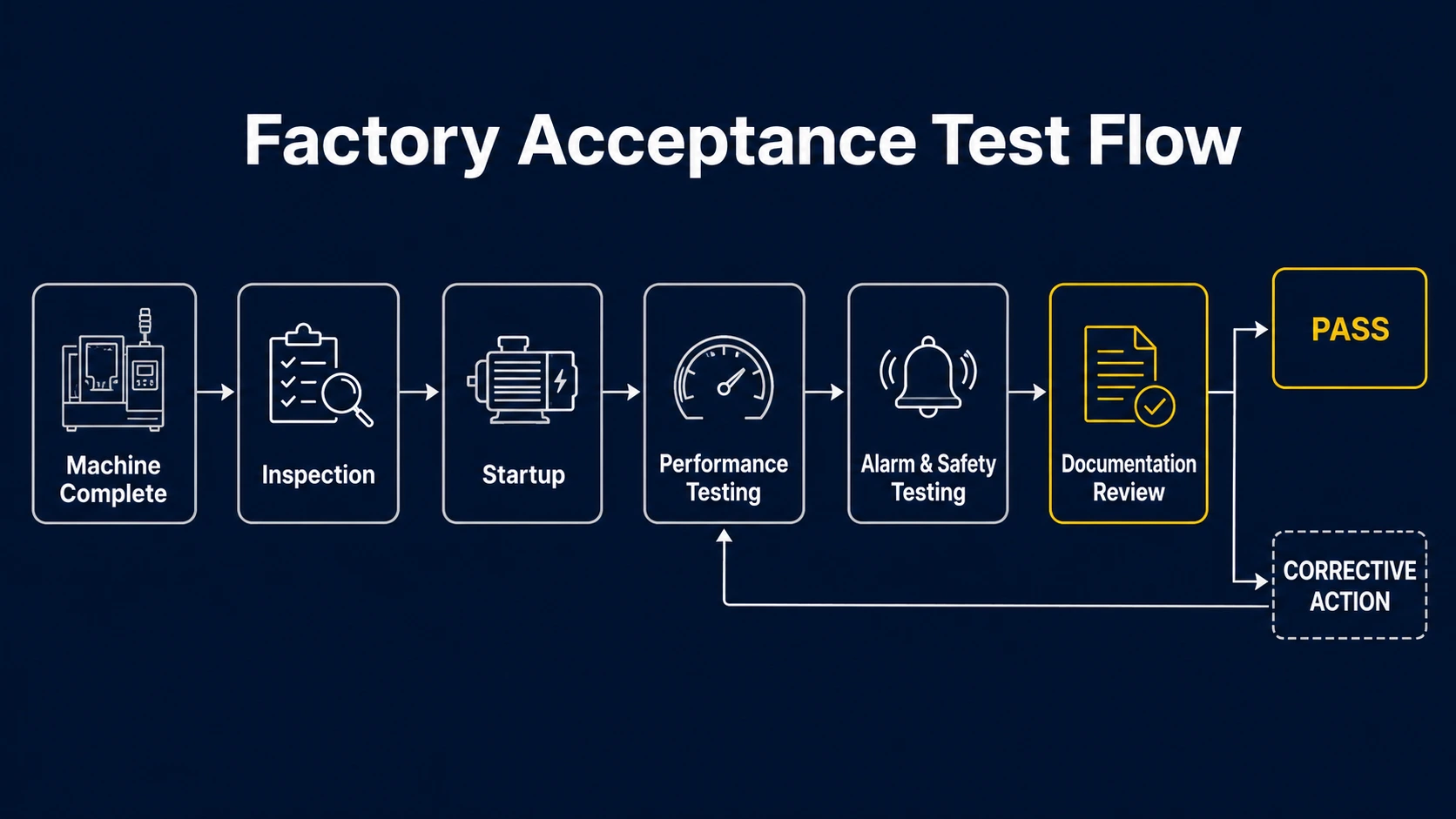 اختبارات القبول في المصنع للمعدات الصناعيةتعرف على كيفية تخطيط وتنفيذ اختبار القبول في المصنع للمعدات الصناعية، بما يشمل البروتوكولات، وأجهزة القياس، والاختبارات الوظيفية، واختبارات الأداء، والانحرافات، والموافقة على الشحن.اقرأ: اختبارات القبول في المصنع للمعدات الصناعية